Categories
Uncategorised

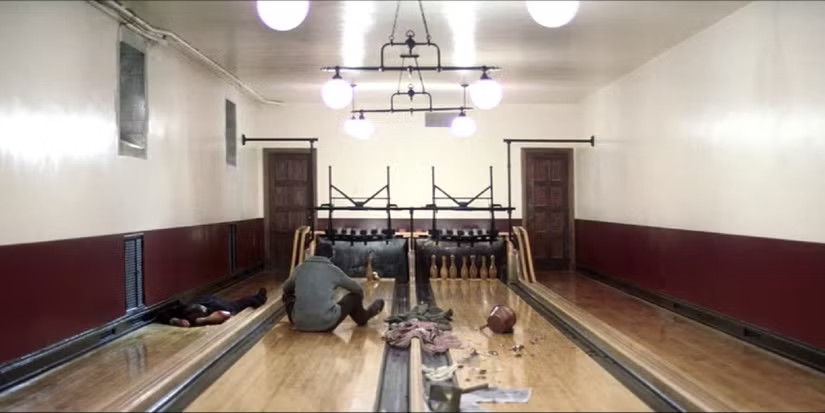
Paul Thomas Anderson: Film Ranking

Paul Thomas Anderson is known for his experimental and fearless quest into exploring characters in ways that are unflinching and at times, uncomfortable.

With the exception of last place (I really struggle with the age-gap in the relationship), I’ve watched these films multiple times and some of them are among my favourite films of all time.

Here’s my ranking for the filmography of Paul Thomas Anderson:

  1. The Master (2012)
  2. There Will Be Blood (2007)
  3. One Battle After Another (2025)
  4. Boogie Nights (1997)
  5. Phantom Thread (2017)
  6. Magnolia (1999)
  7. Inherent Vice (2014)
  8. Punch-Drunk Love (2002)
  9. Hard Eight (1996)
  10. Licorice Pizza (2021)

Which PTA film is your favourite film? Let me know in the comments below!

Categories
Uncategorised

Disneyland Paris – November 2019

Obviously, my blog focuses on the wonderful world of film but I thought that I would take a “half break” and write a post all about my time at the happiest place on Earth. Disneyland Paris is situated outside the city with the Eurostar station located right outside the Disney Village entrance. This was my third time going after previous visits in 2003 and 2016 but this one would prove to be the most successful in terms of rides (the 2016 trip saw several major ride closures) and also FINALLY meeting Snow White which if you know me or read this blog is a big deal. But that is all to come later. We arrived on Monday 4th November and departed Wednesday 6th November which was perfect because a) the park is barely busy and b) we got a chance to see both Halloween and Christmas decorations. Rather than go through the holiday day by day, I thought it would be good to talk about my experiences collectively. It’s hard to talk about one day without talking about another.

We stayed at the Sequoia Lodge Hotel which resembles a forest cabin with decoration inspired by Bambi. Our room was part of the Golden Forest section meaning that we had our own check-in desk and an exclusive lounge where we have breakfast. The room was beautiful as expected and sleeping in the bed was like being inside a giant marshmallow. We struggled to choose between the VIP Golden Forest room at the Sequoia Lodge or a standard room at the Newport Bay Club but what convinced us to go for Golden Forest was the easiness of not waiting for check-in or luggage transfers as we collected it and dropped it off at the counter. Also, being able to start the day in a peaceful and spacious room with no queues for food meant that we could go at our own pace and feel relaxed.

So where to begin? Well, perhaps I should start with the experience of the parks as a whole. As expected, walking into the main park on arrival was incredible as you are greeted by smiles and joyful music that runs through the park. Since we came at the short period between Halloween and Christmas, it did mean that the main square was closed so no lovely photos of the iconic Walt Disney and Mickey statue but that didn’t take away for the always breathtaking view of Main Street as it leads down to Sleeping Beauty’s Castle which acts as a centre point for the park and serves as a handy guide for where to go next. We visited the main park on all three days and Hollywood Studios on days 2 and 3 and the lack of queue times meant we were able to go on the rides more than once which was super handy. This was surprising since two of the biggest rides, The Rock’n’Roller Coaster and Crush’s Coaster in Hollywood Studios were closed for refurbishment. This did not affect the queues for other rides as the longest we waited was 20 minutes for Les Voyage de Pinocchio ride.

The best part about Disney parks is that there is no shortage of things to do. If you’re not fond of rides, you will still find enjoyment in the walkthrough attractions such as the dragon that lies beneath the castle. There is so much detail in the park and Easter eggs for the most obscure films (the Eurostar station has images from Return to Neverland above the luggage pickup kiosks) which is nice to see.

Luckily, my partner, Adam, and I absolutely LOVE rides so we went on as many as we could and because the park was at a low capacity, we were able to go on the rides multiple times. We went on:

Big Thunder Mountain x4

Phantom Manor x4

Star Wars Hyperspace Mountain x4

Blanche-Neige et les Sept Nains (Snow White and the Seven Dwarfs) x3

Peter Pan’s Flight x3

Pirates of the Carribbean x3

Ratatouille: The Adventure x3

The Twilight Zone: Tower of Terror x3

Le Pays des Contes de Fées (The Land of Fairy Tales) x2

Buzz Lightyear Laser Blast x1

It’s a Small World x1

Le Labyrinthe d’Alice (also known as Alice’s Curious Labyrinth) x1

RC Racer x1

Les Voyage de Pinocchio x1

That brings the total times we were on a ride to 34 which averages just over 11 rides a day. Overall, we walked around 60,000 steps over the course of the three days which is equivalent to approximately 25.92 miles. That’s just shy of the length of a marathon! Needless, to say our feet are hurting a lot from the walking but it was worth it and more.

My favourite ride in the parks is Blanche-Neige et les Sept Nains of course. I love the older rides that take you through the stories. They are simple but also bring that sense of nostalgia back. Of course, Snow White and the Seven Dwarfs is my favourite film and this ride encapsulates all of the emotions that the film makes you feel. The animatronics and audio is fantastic and the set design is brilliant. I get chills every time the Evil Queen turns from the mirror and is revealed to be the Hag. I have been on this ride in previous visits so it was from far the first time I have been on it. One of my favourite memories from this holiday was when we were waiting in the Fast Pass queue for Peter Pan’s Flight (which was always ridiculously busy!) and we met a lovely cast member called Manon who also shares a love for Snow White. She kindly gifted us a special fast pass to go back on Blanche-Neige et les Sept Nains and also gave us an autograph book and keyrings of our choice. It made our holiday even more magical and was a wonderful surprise!

My favourite ride that I have not been on was by far Ratatouille: The Adventure. I must admit, I am not a big fan of simulator rides, mainly due to a horrific experience on the Back to the Future ride in Universal Orlando as a child. However, I cannot recommend this ride enough. Ratatouille: The Adventure is exclusive to Disneyland Paris and is a bilingual treat as you sit in a rat car and are thrust into the hectic set of a Michelin kitchen. The use of props and elements like water splashes when a mop is swept towards you really immerse you as you follow Remy’s quest to create the perfect dish. If you have not been on this ride, you need to go on it next time you visit Disneyland Paris.

Another nostalgic treat for me was Le Pays des Contes de Fées, a slow voyage across some of Disney’s greatest story retellings from classics like The Little Mermaid and Aladdin to more obscure offerings such as Pierre et le Loup (Peter and the Wolf) and Oz La Cité d’Émeraude (released in English as Return to Oz) which was a lovely surprise to see at the end of the ride as it was one of my favourite films growing up. I think rides like this are not only enjoyed by everyone but also highlight why people love Disney.

This was my fourth time going to a Disney Park (I went to Walt Disney World Resort in Orlando in 2001 and Disneyland Paris in 2003 and 2016) and on none of these occasions was I able to meet Snow White herself. I was disheartened when the City Hall assistant informed that she would only be making an appearance in the parade on day 2 and accepted that I would not be meeting her this time. However, an impulsive relax on a break would prove genius in the afternoon because low and behold there was Snow White on her way to host a meet and greet. I cannot even begin to explain how emotional this was for me. I have just turned 26 and this event had me feeling the most excited I have ever felt. It was my ultimate Disney dream come true and true enough, it was amazing. She took her time with everyone which was lovely to see and took as many pictures as you wanted. She loved my custom-made Snow White themed ears and even spoke Welsh which was amazing since Wales is often overlooked in Disney’s portrayal of Britain (It’s a Small World does not have a Welsh section sadly). She also promised to bake me a gooseberry pie which was great because who doesn’t love pie?

Leaving was horrible as expected. Even though we had done everything that we wanted to do, we still wanted to stay longer. We’ve already started planning our next Disney trip to either Walt Disney World Resort in Orlando or Disneyland in California and hopefully we won’t wait another four years before going on a big holiday.

Have you been to Disneyland Paris or any of the other Disney parks? Let me know about your experience in the comments below!

Categories
Uncategorised

The Red Shoes (1948)

This technicolour wonderland is one of the best (if not the best!) film in the history of British cinema. Directed by Michael Powell and Emeric Pressburger, It’s become known as a masterpiece and is constantly an inspiration for many artists alike and with good reason. Following Victoria Page (Moira Shearer), a ballerina who joins a troupe as the lead in the new ballet The Red Shoes. She begins to find a conflict between her professional relationship with the insufferable genius, Boris Lermontov (Anton Walbrook) and a personal romantic relationship with the troupe’s composer, Julian Craster (Marius Goring). Soon enough, the ballet of The Red Shoes begins to seep into Victoria’s reality and she is eventually broken down by the idealisations that are expected of her. This is a film that breaks the boundaries of the filmmaking experience. It’s very premise of the ballet within the reality of the film soon becomes blurred and the tone of the film changes from a basic aspirational drama to a psychological thriller. Inspired by the Hans Christian Anderson fairytale but given an original makeover by The Archers (as Powell and Pressburger were collectively known), this film delves into the dark side that fairytales ventured into which is a contrast to the Disney films that were dominating the global market. Even 70 years on, the topics in the film feel just as relevant today.

The Archers’ brilliant direction and script effectively contrast the freedom of dance with the claustrophobia and obsession with perfection. Nothing sums this film up more perfectly than Vicky and Boris’ first exchange:

Lermontov: Why do you want to dance?

Vicky: Why do you want to live?

Lermontov: Well, I don’t know exactly why, er, but I must.

Vicky: That’s my answer too.

red_002after.jpg

Dancing gives Vicky the freedom that she craves but unbeknownst to her in the beginning that the freedom she “gains” from dancing for Lermontov is merely his vision. He is the puppet master pulling the strings. As Vicky grows closer to Julian and begins to finesse her own skills, she begins to resist and she finds herself no longer wanting to dance but unable to rid herself of the red shoes. The ballet sequence in which we see Vicky encapsulate her character and venture into the nightmare world of the dance is horrific. Her own emotions have merged with the character. Her dancing has become her life force. Then there’s the conflict she has between Julian who is an aspiring musician who is working for pennies and has the freedom to create the material he wants and then Lermontov who requires strict control over the whole operation. I think it is to Powell and Pressburger’s credit that they manage to succeed in creating three entirely different yet well-rounded characters who all have their motives and flaws. It’s a film that feels progressive even now and doesn’t belong to a particular time. It’s reluctance to slot into a specific genre is also reflective of this as it is a drama, thriller, horror, dance piece all in one.

I think that Shearer’s performance is one of my favourites in any film. She shines as Vicky and really brings out the talent and the grandeur of the role. Despite her privilege (we first see her sat in a private box watching the ballet), Vicky shows her natural passion and talent which impresses Lermontov who initially dismisses her because of her background. Despite Vicky’s flair for ballet, she is still an outsider as her fellow dancers clearly do not have the luxuries that she has. No scene depicts this better than when she thinks she is going to dinner and is dressed to the nines complete with a tiara, only to find the men running the ballet planning the next production in casual attire. Vicky is by no means a perfect individual either. She throws a tantrum when she is unable to keep up with Julian’s tempo during rehearsal. Vicky and Julian’s relationship develops as they realise that they are two sides of the same coin which Lermontov despises. The complexities of Lermontov’s character makes him one of my favourite “villains” film history. His obsession dehumanises those around him, none more so than prima ballerina, Irina Boronskaya (Ludmilla Tchérina) who is abandoned by Lermontov when she announces her engagement. The people around Lermontov are dehumanised puppets where his ambitions must become their ambitions. The moment there is any hint of a life outside the ballet, they are exonerated and in Lermontov’s eyes, they never even existed. His unapologetic way of life is challenged by Vicky and the climatic scene shows a crack in the façade as he breaks down onstage and forces the production to commence without her. The vision becomes empty and the audience gazes at a moving spotlight as it flutters around the stage where Vicky should be.

irina

The music composed by Brian Easdale is nothing short of extraordinary and it effortlessly dances the line between the ballet production and the film reality until eventually both worlds merge into one. The music used in the production of The Red Shoes is spectacular with the church scene in particular remaining a highlight for me. I get chills every time I watch that segment and hear the constant bell as the lead is abandoned and left to die. Jack Cardiff’s choreography for the film is a perfect marriage for the score and the two sail on through the film and set the pace. These components are representative of Julian and Vicky’s talents and the importance of the part that they play into the film cannot be unrecognised. One of my favourite aspects of the film is Hein Heckroth‘s costumes designs. The moment when Vicky’s costume for the ballet of The Red Shoes is revealed is breathtaking and it’s one of my favourite costumes in film. Not to mention the incredible costumes that Vicky wears throughout and the clothes designed by Carven for Irina are exceptional.

My love for this film grows with every view and even thinking about it now, it’s incredible how much it has shaped my taste in film and been such a huge influence in my creativity. It’s such a beautiful film that deserves more than one watch and I think it should be on every film lover’s watch list if they haven’t already seen it. It truly deserves its masterpiece status and remains an important part of cinema history.

What do you think of The Red Shoes? Let me know in the comments below!

Categories
Uncategorised

A Nightmare on Elm Street Ranking

If you had to ask me what my favourite horror franchise is, I would say A Nightmare on Elm Street with no hesitation. Home to Wes Craven’s iconic slasher villain, Freddy Krueger, a dream-haunting nightmare with knives for fingers on one hand. He’s disgusting and terrifying and doesn’t let his victims die easily. The first film was released in 1984 and has seen multiple sequels, a reboot and even a feature mashup with another certain horror icon. They’re not to everyone’s taste due to their extreme violence and inappropriate content but as a horror fan, I find them fun to watch. Kruegar is the first truly charismatic slasher to come from this genre as Jason and Michael Myers silently stalk and kill their prey. Freddy on the other hand likes to torment his victims and is constantly making grim jokes about their pending demise. Wes Craven has always been a skilled filmmaker but he really reached his peak with this creation. It’s brilliant and crosses the line between horror and humour. This makes the films entertaining and, dare I say, enjoyable to watch.

Now I’ve already done a ranking for the Child’s Play and Final Destination films which you can read here and here, respectively, but I thought it would be fun to look at this franchise as a whole and see where the films would slot from best to worst.

Without further ado, let’s delve into the nightmare and get on with the reviews:

A Nightmare on Elm Street (1984)

The one that started the nightmare. A Nightmare on Elm Street is a pioneer in the slasher genre, coming after Halloween (1978) and Friday the 13th (1980). Spearheaded by horror legend, Wes Craven and featuring Robert Englund as the gruesome killer, Krueger, we are plunged into a world that sees the teens of Elm Street slashed to death one by one. The film is widely known for its explicit violence, paedophilic themed subtext and also marked Johnny Depp’s film debut. A group of teens start being killed off one by one, apparently by a badly burned man with knives for fingers. Led by Nancy Thompson (Heather Langenkamp), the group work together to trap and kill the monster. It’s an iconic film. Even if you haven’t heard of it, you know what Krueger looks like and the basic premise of the film. Nancy is a brilliant protagonist and just like Laurie Strode in Halloween franchise, she is fearless when needed. It’s strange to think that a genre associated with the subjectification and glorification of violence towards women (which is a completely legitimate issue) also provides such progressive roles for women as well. There’s a humour in this film that you don’t really see in other slashers that would set a trend for franchises like Child’s Play and the sequels for Friday the 13th which purposely become weirder as the films went on.

nightmare1.jpg

A Nightmare on Elm Street 2: Freddy’s Revenge (1985)

It’s no secret that I love camp horror films. I love a film that isn’t afraid to be highly satirical of itself and the genre. Despite only being released a year before, Freddy had become somewhat of a titan of horror. A sequel was rushed through with no involvement from Craven and the result is the polar opposite of its predecessor. The film follows the Walsh family who move into the Thomson family home five years after Freddy’s initial defeat. Teenage Jesse (Mark Patton) is struggling to fit in and finds himself getting into fights with his peers at school but his world is quickly flipped when the people who . The film has become a cult classic among fans and is known for its homosexual undertones with Englund himself declaring it a “bisexual film”. There is a strong argument to suggest that Jesse’s inability to fit in is due to his conflict with his own sexuality. The big issue that I have with this film is that it flips Freddy around to be the hero. When he’s bullied by a group of partying teenagers, the audience sympathises with him. This sentiment was shared by Craven himself who stated that Freddy should be “threatening and overpowering” which I think was missing. Freddy becomes a punchline in this feature rather than a genuine threat.

A Nightmare on Elm Street 3: Dream Warriors (1987)

This sequel does not get enough love. Coming off the failure of the previous installment, Dream Warriors is a brilliant addition to the franchise. It’s known among fans of the franchise that this film is fantastic but not as well known to horror fans in general who truthfully are missing out. Following a group of young people in a psychiatric ward, we see Freddy messing with the minds of these vulnerable individuals and watch as their pleas are quashed by the doctors and other authorities figures. The film marked Patricia Arquette’s film debut as Kristen Parker, a young teen who is chased in her dreams by Freddy who then cuts her wrists which looks like a suicide attempt to her mother who swiftly commits her to Westin Hills psychiatric hospital. She teams up with a group like her who have had nightmares of the same man and soon they are killed one by one. Calling themselves “dream warriors”, they plan to use their weaknesses as strengths to quash Freddy’s murderous attempts. The film also marks the welcome return of Heather Langenkamp as Nancy who has grown to be a psychiatrist, inspired by the events of her childhood. This film features some of the best death scenes in the franchise and sees Craven taking control of his franchise once again.

A Nightmare on Elm Street 4: The Dream Master (1988)

The film follows the remaining survivors of the third film (Tuesday Knight taking over the role of Kristen Parker) after they have been released from the psychiatric unit one year later. Kristen is still haunted by what happens and Freddy returns to cause havoc on the survivors and their school friends. This is where the films start to play the same routine and becomes more repetitive but trying to make the death scenes as ridiculous as possible. There is even a death where one of the girls is turned into a cockroach and squished! It’s still a good popcorn flick but largely unoriginal. This film also features Lisa Wilcox as new protagonist, Alice Johnson, who takes the helm as scream queen for this segment after befriending Kristen. I like the aspect of bringing someone else into the dream which is continued from the third film into this one. Freddy uses Alice to lure him to her friends who he starts to pick off one by one, including a horrific death involving her asthmatic friend. This installment was the highest grossing the original franchise and kept it that way until 2003’s Freddy vs. Jason so it was a huge hit with audiences.

A Nightmare on Elm Street 5: The Dream Child (1989)

The fifth film follows Alice (Lisa Wilcox) who is still haunted by the events of the fourth film. The opening scene throws us immediately into the dream world as we see Alice as Amanda Krueger, a nun who works in a men’s psychiatric ward who is subsequently raped by masses of inmates when she is accidentally locked among them. She has a second nightmare that sees Freddy as a baby digging up his remains from the fourth film and brings him back to life. After Alice’s boyfriend, Dan (Danny Hassel), dies tragically, Alice is convinced that Freddy is back which is swiftly followed by the revelation that she is pregnant and Freddy subsequently starts to give the unborn baby powers so he can be more like him. There is a lot going on in this film and the more I think about it, the more confused I become. There’s the usual plotline of Freddy killing teenagers then the subplot of Alice’s pregnancy and then there’s the second subplot involving Freddy’s origins. It’s a lot to cram into one film and naturally the film fails because of it.

Freddy’s Dead: The Final Nightmare (1991)

This installment is by far my least favourite. If you thought the previous film was overcomplicated then you’re not prepared for this one. Freddy has killed all the kids and teenagers in a small town and seeks out the one survivor to bring more teens to kill. There are so many questions that come to mind regarding the cannon and where this sits in the universe as there is no reason for his reincarnation from the last one. The adults in the small town have gone insane and there is definitely a strange Twin Peaks tone that they are going for that fails spectacularly. This is probably the rock bottom for the original franchise and seems to just be a money grab rather than a genuine passion project. It also features a cameo from Johnny Depp and a bizarre cameo from Roseanne Barr who plays one of the deranged townspeople.

Wes Craven’s New Nightmare (1994)

This film takes place outside the universe and is a unique experience as it is very meta. Following the making of a new film, Freddy breaks out and starts killing the cast and crew. Featuring a return from Heather Langenkamp and with many of the other parts played by cast and crew. Wes Craven returned for the project and the great thing is that it seems like everyone is genuinely having fun. It’s a shame that this film had become largely forgotten as it is a great addition to the franchise. It’s to Craven’s credit that he is always trying to think of something new while still being faithful to the originals. The Freddy in this film also goes back to darker routes and becomes less comical than the last few installments.

Freddy vs. Jason (2003)

This film is one of those that is so bad it’s great and I love it. Freddy resurrects Friday the 13th villain, Jason Voorhees in a bid to scare the residents of Elm Street while they’re awake so he can kill them while they sleep. Soon enough, Jason starts going on a killing spree which angers Freddy and the two become embroiled in a feud that brings a huge body count. It’s a fun film that ventures on the wackier side and also serves up a variety of stereotypes in an ironic way such as the resident stoner and drunk partying teens. The film is the last to feature Englund as Krueger and stars Ken Kirzinger as Jason. It’s a shame they didn’t follow this up with a sequel as it would have been great to see what more they can do with this universe cursed with this villains. It’s not a great film by any means but it’s a fun popcorn flick. I think what makes this film so enjoyable to watch ishat it isn’t afraid to poke fun at itself and be completely bonkers.

A Nightmare on Elm Street (2010)

This is one of those rare films where I go against the grain a little bit. This film was (rightfully) torn apart by critics like one of Freddy’s victims despite its commercial success. It is equally hated by fans and despised so much that they didn’t even bother making any sequels for this reboot. It’s a rehash of the first film with newcomer Rooney Mara filling the boots for Nancy Thompson. The reason I go against the grain is that I am one of the few people who actually enjoyed this reboot. Don’t get me wrong, it doesn’t hold a candle besides the original at all but I thought it was an interesting take in bringing up the darker themes that couldn’t be discussed in the original, mainly Freddy’s paedophilic nature. I think Jackie Earle Healey is one of the most underrated actors working today and his performance is a darker take on Englund’s Krueger. I understand why his performance wasn’t well received because the humour and charisma is what differentiates Kruegar from other slasher villains. Also, Mara is one of my favourite actresses working today and this is the film that properly introduced me to her (aside from The Social Network but that was a small support role). I thought that the darker tone was an interesting aspect to explore but I do think ultimately the film suffers because of this and becomes just another horror film.

So that’s all of the reviews done and dusted. I am not sure if they’re going to create anymore, especially since Craven has since sadly passed, but it would be intriguing to see how they would reintroduce Freddy in this new revolutionary climate.

Here is my ranking:

1) A Nightmare on Elm Street (1984)

2) A Nightmare on Elm Street 3: Dream Warriors (1987)

3) A Nightmare on Elm Street 4: The Dream Master (1988)

4) A Nightmare on Elm Street 2: Freddy’s Revenge (1985)

5) Wes Craven’s New Nightmare (1994)

6) Freddy vs. Jason (2003)

7) A Nightmare on Elm Street 5: The Dream Child (1989)

8) A Nightmare on Elm Street (2010)

9) Freddy’s Dead: the Final Nightmare (1991)

What do you think? Which one is your favourite? Let me know in the comments below!

Categories
Uncategorised

Final Destination Ranking

The franchise that was one of my first introductions to the horror genre. The Final Destination franchise is almost a passage of rite for teens and have been massively popular since the first installment dropped in 2000. The basic set-up follows a teenage protagonist and their friends on some sort of adventure or activity when the protagonist suddenly has a tragic premonition that sees their demise. The protagonist then prevents them and their friends going through with the premonition only to discover that the group starts to die violently and mysteriously one by one.

With the news that the studios have sixth and seventh installments planned for release, it made me think back on the films that helped shape my love for horror and I thought it would be a nice idea to see where they would rank.

Here are my reviews for each installment:

Final Destination (2000)

The one that started the craze. We follow recent graduate, Alex Browning (Devon Sawa) who is venturing off to Paris with his classmates. He suddenly has a graphic premonition that sees the plane explode and every passenger diminishes. Alex freaks out and is escorted off the plane along with several of his classmates. Minutes after the plane takes off, it explodes and Alex finds himself under police investigation. It doesn’t end there however as the survivors start to die one by one in violently crazy ways as death seeks its revenge. The film brings something new to the table while also paying homage to previous franchises such as the welcome cameo by Tony Todd who works as a mortician. As the film goes on, the deaths become more and more elaborate compared to his friend Tod’s demise due to strangulation to his teacher’s death sequence which saw her computer explode, followed by a knife to the chest which was pushed in by a chair. We see Alex’s descent into madness as death becomes his nemesis and he escapes to a cabin in the woods with the help of his friend Clear (Ali Larter), who believed in him from the plane accident.

FinalD1Feat-1024x660.png

Final Destination 2 (2003)

This is one of those rare franchises where the sequel is better than the original. The second installment takes the ideas from the first film and builds on them. The film follows Kimberly Corman (A. J. Cook) who has a premonition of a major road accident on a motorway that sees a huge body count. Like the previous film, she freaks out and saves herself and others only to discover that the survivors are being stalked by death. There are so many iconic sequences in this film and it’s pretty much every death. From teenager Timmy being squished by a falling window pane to the creepy ladder through eyes fiasco with young millionaire, Evan. This sequel turns up the ante and the body count. It’s gruesome and brilliant and the acting and writing is a big improvement on the first installment. It also incorporates a new theory on evading death where life can counteract death and eliminate the whole list which is an interesting twist. We also see Ali Larter return as Clear and Tony Todd reprising his cameo. I don’t care what anyone says, I have a soft spot for this film and I think the deaths are great and imaginative.

Final Destination 3 (2006)

The most famous and recognisable installment comes with the third film which features the incredible rollercoaster premonition. Starring Mary Elizabeth Winstead as Wendy in a role that would solidify her position as the 21st century “scream queen”, Final Destination 3 has an abundance of imaginative sequences that have long tortured the minds of teens alike namely the sunbed death which sees two girls trapped and burned alive by their sunbeds where the temperature has been mysteriously tampered with. If I had to rank individual performances from the whole franchise, I would probably say by Winstead is by far and large the best of the bunch. It’s a really involved performance filled with guilt and sadness. This performance is what thrusted Winstead into the spotlight where she has managed to grow into a star. It’s nice to see that happen in the modern day the same way horror made stars of  Jamie Lee Curtis (Halloween) and Patricia Arquette (A Nightmare on Elm Street 3: Dream Warriors). It also features great support performances from Kris Lemche and Alexz Johnson as goth couple Ian and Erin who aren’t fazed by the concept of being chased by death.

The Final Destination (2009)

By far the worst installment, The Final Destination is a film that underestimated its audience and provides a film that is neither fun or memorable. The premonition takes place at a race track where a tyre flies off a speeding car and hell breaks loose. They shot this with 3D in mind and it shows. The studio was more bothered about making sure random objects and body parts are flying at you so much that they forgot to include any creativity in the process. It’s not a franchise known for its deep characterisations (nor do we expect it to be) but none of the characters are particularly likeable and they are all one note. The death sequences are predictable and elongated with some lasting way longer than necessary (the organs in the swimming pool drain being a prime example) and it soon becomes a tedious experience to watch. In a totally bizarre twist, this installment is by far the highest grossing in the series so far so Thankfully, the studios veered away from this aspect in the fifth installment.

IN03_CP04_FINAL_DESTINATION.jpg

Final Destination 5 (2011)

The fifth and latest installment of the franchise looks back to the original for inspiration and becomes more old school. After the critical failure of the fourth film, the studios reflected on what went wrong and made what is the “best” installment in the franchise. The script is actually tight and the characters are well-developed compared to the other films. The opening disaster is a road accident which sees a bridge collapse while a group of colleagues are on their way to a work retreat. It’s a simpler set-up than previous installments but the effects are brilliant and the deaths are just as gory. Like the fourth film, this was also released in 3D but it didn’t feel as though they were just catering for 3D and the use of it was interesting and minimal. It didn’t need the 3D to succeed but it did amplify the experience in the cinema. Following Sam Lawton (Nicholas D’Agosto) who has the premonition and the usual set-up of rescuing his friends. This installment has an array of theories and twists that are not overthought or complicated and works brilliantly as a franchise installment and also a standalone.

With all of this said and done, I am even more excited for the new installments to be released. I think that the Final Destination idea is really interesting and they’re great fun to watch. I’ll definitely be front and centre on release day with a box of popcorn in hand.

I think it’s a credit to the writers for the franchise that all but one of the sequels managed to surpass the original and even the film that is deemed the worst was the one that made the most at the box office. There is a huge audience for these films and it’s a shame that there’s been such a big gap between the last installment and now.

Here is my final ranking:

1) Final Destination 2 (2003)

2) Final Destination 5 (2011)

3) Final Destination 3 (2006)

4) Final Destination (2000)

5) The Final Destination (2009)

What do you think of the ranking? Do you agree or disagree? Let me know in the comments below!

Categories
Uncategorised

Top 5 Andrew Garfield Performances

Andrew Garfield is one of the most exciting millennial actors out there with a huge resume under his belt that boasts film, theatre and television. Since his breakout role in David Fincher’s The Social Network, Garfield’s talents have gone from strength to strength and his career has brought him an Academy Award nomination, two BAFTA nominations and a Tony Award for his performance in the Broadway production of Angels in America. He’s a fearless actor and clearly wants to stretch himself and show off the range he has.

His filmography isn’t as extensive as his television and stage work but this proves the care that he takes in selecting his roles. One his earlier roles that I absolutely adore is The Imaginarium of Doctor Parnassus (2009) which in true Terry Gilliam style is utterly bonkers but Garfield is wonderful as troupe member, Anton. The fact that that performance doesn’t even make the top 5 just shows his skill as an actor.

Without further ado, here are my top 5 Andrew Garfield performances in chronological order:

The Social Network (2010)

The one that gave him his big breakout into the mainstream, Garfield plays Harvard student, Eduardo Saverin a seed investor for Thefacebook, a website created by fellow student and friend, Mark Zuckerberg (Jesse Eisenberg). In this biopic following the founding of the world’s biggest social media platform, we see Garfield in a significant supporting role in which sees him as a crucial part of Facebook’s inception and then ultimately his ownership is reduced and his profit is minimal. Bolstered by a stellar script by Aaron Sorkin and brilliant direction by Fincher, the part of Saverin is already a meaty role but Garfield goes the extra mile and makes the most of his limited screen time. Even when he is not on the screen, his impact is felt throughout the film. It shows that even at the early stages of his film career, Garfield is looking for risky roles. Not to mention the perfect delivery of the line: Sorry! My Prada’s at the cleaners! Along with my hoodie and my ‘fuck you’ flip-flops, you pretentious douchebag!

Never Let Me Go (2010)

Based on the novel of the same name by Nobel prize winner Kazao Ishiguro, Never Let Me Go is a nostalgic dystopic story about unknowing clones who are raised and brought up to be harvested for their organs. Following the three protagonists Kathy H (Carey Mulligan), Ruth C (Keira Knightley) and Tommy D (Garfield) who are three donors. We watch their journey from their innocent childhood to fully aware adults and the deterioration of their friendships and their lives as they are forced to donate their organs and start dying in the process. Garfield holds his own against this starry cast which also features Charlotte Rampling and Sally Hawkins to name a few. Tommy D is such a complex character as he begins to express his feelings through art in the hope that this will save him and Kathy H. At the start of the film, Tommy is an angry young boy who doesn’t know where to project his frustration but the adult Tommy is more restrained. You can see the tension bubbling to the service with Garfield’s performance and the climactic scene in which he breaks down is heart-breaking to watch. Watching the desperation as Tommy accumulates years and years of art in which his love is expressed and ultimately rejected makes for one of the best performances of the year that was sadly overlooked.

andrewgarfield

99 Homes (2014)

Now for my favourite Garfield performance. Fresh off the back from starring as Peter Parker in The Amazing Spider-Man and it’s subsequent sequel, you’d be forgiven for thinking that Garfield would be starring in blockbuster after blockbuster. However, he not only starred but also co-produced his next film 99 Homes, an indie following construction worker, Dennis Nash (Garfield) and his struggle to keep a job which leads to his family being evicted from their home. The eviction is led by the ruthless Rick Carver (Michael Shannon) who Nash starts to work for and begins to be led down a rabbit hole of corruption and deceit. It shows the desperation to survive in a failing climate and what people will do in the pursuit of security. Nash commits awful criminal and moral activities but we don’t judge him for it because we know the background behind this and the intentions. When Dennis is forced to carry out an eviction, his reaction is the complete opposite to Rick’s emotionless demeanor. Whereas Shannon thrives portraying impenetrable characters, Garfield’s characters always wear their heart on their sleeve and none more so than Dennis Nash. Shannon definitely dominates the film as a whole and also provides one of his own career bests but Garfield’s performance should not be overlooked because of this. Seeing him play a young, struggling father who is also tasked with taking care of his mother (Laura Dern) demonstrates his range and versatility.

Hacksaw Ridge (2016)

The biggest performance of his career so far and one that cemented him as a reliable leading man, Garfield leads this biopic about Desmond Doss, a pacifist soldier who acts as a doctor during the Battle of Okinawa at Hacksaw Ridge. Doss refuses to engage in any violent act and even goes into battle without a weapon to protect himself. He was renowned for savings the lives of countless soldiers on both sides. The film itself was a bit overrated as a whole in my opinion (it felt like an imitation of Full Metal Jacket in the first half and is overall an oddly paced film) but Garfield shines in the lead role. There are some unbelievably brilliant scenes such as the climb up the Ridge when the soldiers realise that the rope ladders is soaked with blood. The film is definitely worth a watch just for Garfield’s performance alone and was well worth the Oscar nomination it received. The film was met with controversy thanks to Mel Gibson’s involvement as director and his subsequent awards attention. In my opinion, however, I find his direction a bit too indulgent in this film and not one of the highlights. This is a film that Garfield alone elevates, telling the story of a peacemaker’s experience in the eye of a bloody war.

hacksaw_ridge

Silence (2016)

2016 was unarguably a brilliant year for Garfield. His second feature of the year sees him working with Martin Scorsese in an adaptation of Silence as Father Sebastião Rodrigues, a Portuguese priest who ventures to Edo era Japan to seek out fellow priest Cristóvão Ferreira (Liam Neeson). The film is set during the Shimabara Rebellion that sees Christianity outlawed and anyone who refuses to denounce Christ tortured or killed. Accompanied by Father Francisco Garupe (Adam Driver), Sebastião’s faith is tried and tested throughout as this 3 hour epic follows the trials and tribulations of a suppressed community in a land where they are outsiders. The film is a slow burner but it is a deeply layered film with rewardingly textured performances. Both 2016 films see Garfield play devout Christians in war-torn Japan at different eras but the performances couldn’t be further apart. The psychological effects of torture that Sebastião is forced to endure is shown perfectly by Garfield. We feel Sebastião’s inner turmoil as his reluctance to denounce Christ harms not only himself but others around him.

It’s exciting to see an actor unafraid to showcase a diverse range in a multitude of mediums. He has achieved a lot in a relatively short amount of time and it’s exciting to see what projects he takes on next.

Which Andrew Garfield performance is your favourite? Let me know in the comments below!

Categories
Uncategorised

Nosferatu the Vampyre (1979)

The vampire genre is one that has proven longevity since the popularity of Bram Stoker’s Dracula. Since the inception of film as an artistic genre, we have seen vampires populate horror ever since the 1922 classic Nosferatu. It’s a genre that has become a parody unto itself thanks to its association with teen franchises and the common link between vampirism and sex. What makes Werner Herzog’s 1979 masterpiece so impactful is the sincerity and the minimalism with which it is executed. Herzog brings such a natural approach to the production and yet everything is so clearly calculated. Starring Bruno Ganz as Jonathan Harker, Isabelle Adjani as his wife, Lucy and Klaus Kinski as the titular character, the film follows the story of Jonathan Harker and his encounter with the mysterious Count Dracula who lives among ruins in Transylvania. Dracula subsequently ventures into Wismar and brings along a rat infestation causing a plague in the village while feeling entranced by Lucy. The film is a haunting adaptation of the classic tale and with minimal violence, effectively mounts up fear thanks to the emotionally charged script and the isolating direction.

First thing to talk about is Herzog’s direction and screenplay which I have touched on a bit. What’s genius about Nosferatu the Vampyre is its timelessness. It’s a film that could have been made today and still received in the same way. I think that is a credit to Herzog’s talent as a writer and filmmaker that he is able to create a film that is so unique and provided an impact to the horror genre. The first act of the film follow Jonathan’s journey to Transylvania and is fairly slow burning with the middle portion showing Jonathan’s encounter with Nosferatu and his downfall and the final act sees the plague takeover and final showdown. Herzog successfully creates rounded characters in its main three protagonists: Jonathan, Lucy and Dracula and easily follows their isolated storylines before merging together in Wismar. The film becomes an intricate puzzle and Herzog cleverly manages to slot the pieces in the right place by making it more than a simple linear structure.

Nosferatuwinedinner.jpg

Due to the lack of blood and violence, it’s up to the actors to evoke the fear in the film and the cast does so perfectly. Headed by Ganz and Adjani as the Harkers, we are immediately immersed in their world from the opening shot of Lucy screaming herself awake from a nightmare. Kinski isn’t physically in the film that long and first appears halfway through but his presence can be felt even when he is not onscreen. As we see Jonathan succumb to vampirism, we see his attitude shift from loving husband to isolated madman in a performance that is portrayed brilliantly by Ganz. The highlight for me comes from Adjani for her stellar performance as Lucy. Considering the film was made in 1979, Lucy is such a complex character. Herzog makes the audience believe that she is weak and feeble as she struggles to cope when Jonathan sets off on his journey but her strength shines through in the aftermath of the plague that sets upon Wismar. As we see a society led by men crumble, Lucy can be seen actively trying to solve the problem against the advice of the supposedly wise Dr Van Helsing (Walter Ladengast). The nightmares and instincts that Lucy create a sense of otherworldliness to her as she is viewed as a force for Good against the Evil of Nosferatu.

I don’t think I would be doing the film justice if I were not to discuss the iconic soundtrack provided by Popol Vol and featuring the Vocal Ensemble Gordela. The score brings in new sounds and unexpected notes which exemplify the films various twists and turns. It’s hauntingly beautiful and grabs your attention instantly. The score helps the film’s impact on the viewer and really elevates the experience and horror of the subject matter. The track “Tsintskaro” performed by the Vocal Ensemble Gordela is among the many musical highlights in this film as we see Lucy as she ventures through the town square among the madness of the fellow villagers. The incorporation of this traditional folksong brings forth the culture into the film and it clearly made an impact as it also provided inspiration for Kate Bush who sampled this song in “Hello Earth”.

nosferatu

It goes without saying that Nosferatu the Vampyre is my favourite vampire film and among my top horrors of all time. I think that there is a strong argument to say it is the best vampire film of all time and struggle to think of a horror film that has impacted me more. It’s brilliance comes in its simplicity and its fear comes from the performances which shows what a fantastic cast and crew this film had. All the components mesh together beautifully to create a film that is still haunting and impactful 40 years on.

What do you think of Nosferatu the Vampyre? Let me know in the comments below!

Categories
Uncategorised

Disney Animated Classics: Final Ranking

So after months of reviewing and ranking the Disney Animated Classic library, I have finally got my finished list. I thought it would be a bit easier than what it was and found my opinion and outlook changing on a fair few of the films.

If you haven’t read this series then here’s your chance!

Films 1-5

Films 6-10

Films 11-15

Films 16-20

Films 21-25

Films 26-30

Films 31-35

Films 36-40

Films 41-45

Films 46-50

Films 51-57

Here we go with the final ranking from bottom to top:

57) Winnie the Pooh (2011)

56) Chicken Little (2005)

55) Dinosaur (2000)

54) Home on the Range (2004)

53) Meet the Robinsons (2007)

52) Make Mine Music (1946)

51) The Rescuers Down Under (1990)

50) Fantasia 2000 (2000)

49) Melody Time (1948)

48) Saludos Amigos (1948)

47) The Adventures of Ichabod and Mr. Toad (1949)

46) Fun and Fancy Free (1946)

45) The Fox and the Hound (1981)

44) Lady and the Tramp (1955)

43) Oliver & Company (1988)

42) Robin Hood (1973)

41) The Rescuers (1977)

40) Big Hero 6 (2014)

39) Bolt (2008)

38) Ralph Breaks the Internet (2018)

37) Cinderella (1950)

36) The Sword in the Stone (1963)

35) The Jungle Book (1967)

34) Brother Bear (2003)

33) Treasure Planet (2002)

32) Zootopia (2016)

31) Wreck-It Ralph (2012)

30) The Great Mouse Detective (1986)

29) Atlantis: The Lost Empire (2001)

28) The Black Cauldron (1985)

27) Hercules (1997)

26) Dumbo (1941)

25) Frozen (2013)

24) Tarzan (1999)

23) Pocahontas (1995)

22) Pinocchio (1940)

21) The Three Caballeros (1945)

20) Peter Pan (1953)

19) Moana (2016)

18) The Princess and the Frog (2009)

17) Lilo & Stitch (2002)

16) The Hunchback of Notre Dame (1996)

15) The Emperor’s New Groove (2000)

14) One Hundred and One Dalmatians (1961)

13) The Aristocats (1971)

12) Aladdin (1992)

11) Alice in Wonderland (1951)

10) Tangled (2010)

9) The Little Mermaid (1989)

8) Mulan (1998)

7) The Lion King (1994)

6) The Many Adventures of Winnie of Pooh (1977)

5) Bambi (1942)

4) Sleeping Beauty (1959)

3) Beauty and the Beast (1991)

2) Fantasia (1940)

1) Snow White and the Seven Dwarfs (1937)

So that’s the full ranking! What do you think? Let me know what Disney films are your favourites in the comments below!

Categories
Uncategorised

Disney Animated Classics: Numbers 51-57 Ranking

We finally made it! After months of reviews and rankings, this is the final post before we are all up to date before Frozen II hits cinemas. This series of posts have taken us through not only the history of Disney but also a history of animation as we transition from hand-drawn to computer animation. Going from more traditional fairytale retellings to complex stories about identity and love, Disney continues to better itself as a studio although there is still a long way to go. Much like the animation studio in Burbank, it is held up by its traditions like the statues of the Dwarfs that hold up the building itself. This bunch of films sees Disney poke fun of its past in a bid to expose the mistakes that have been made in its portrayal of serious issues such as gender stereotypes and racism. In doing so, it tends to fall flat at times as the gestures don’t seem sincere and apologetic but it is made with good intentions.

We also see Disney’s most successful film as well as the first Best Animated Feature Oscar winners that aren’t Pixar. Disney seems to have found its footing in a landscape dominated by computer animation by using nostalgic elements such as Disney princesses but making them modern. With Disney being the most powerful studio in the world, they are able to recruit star-studded casts and the best crew such as Lin-Manuel Miranda’s stellar soundtrack for Moana and Idina Menzel and Kristen Bell as the two sisters in Frozen.

Just in case you need a refresher, here are the previous installments:

Films 1-5

Films 6-10

Films 11-15

Films 16-20

Films 21-25

Films 26-30

Films 31-35

Films 36-40

Films 41-45

Films 46-50

This list includes the last hand-drawn feature before Disney announced its dedication to computer animation and also includes some of the most progressive films in Disney’s catalogue. These films clearly have an aim to push strong female characters in them and although it isn’t perfect, it’s a step in that direction. There are areas as I have said previously where Disney need to step up such as including LGBT+ characters and a wider array of cultural backgrounds that don’t fall into stereotypical tropes. The films from Disney aren’t perfect but they are trying to right the wrongs of the past while also reflecting modern politics in a way where they please everyone. I don’t necessarily agree with their philosophy but they are a brand and revenue is one of the most important (if not THE most important) factor in the Disney process. Hopefully, they learned from the straight-to-DVD sequel, prequel fiasco of the early noughties and go back to creating films with heart where the audience is the primary focus rather than their pockets.

Without further ado, here are the reviews for films 51-57:

51) Winnie the Pooh (2011)

Marking Disney’s last hand-drawn feature, Winnie the Pooh seems to mark the end of an era as Disney begins to embark on computer-animated films only. I am really sad to say that this film falls flat for me. I just didn’t find it enjoyable in the slightest. The animation is off, the plot is boring and the characters aren’t as lovable. I mean, this is Winnie the Pooh we’re talking about. The characters are loved all around the world but this adaptation mauls the text and tarnishes the franchise. Luckily, we still have The Many Adventures of WInnie the Pooh to enjoy and we can forget about this mess of a film. The animation of the animals isn’t too bad but the design of Christopher Robin and the background looks out of place.

WINNIE-jumbo.jpg

52) Wreck-It Ralph (2012)

Showing that Disney is still capable of producing original material, Wreck-It Ralph follows the titular character (voiced by John C. Reilly) who is the villain of an arcade game wanting to be the good guy for once like “Fix-It Felix”, the insufferable character who defeats Ralph numerous times a day. Ralph is despised by the fellow tenants of the apartment block that he tries to destroy. Sick of the same routine, Ralph escapes to Sugar Rush, another game where players race through lands of candy. There he encounters the tiny Vanellope von Schweet (voiced by Sarah Silverman), a funny and sassy aspiring racer who is also an outcast due to her glitch. Together, they try to become heroes when the arcade’s future is thrown into uncertainty. It’s a film full of nostalgia with its inclusion of iconic game characters such as Pacman and Sonic the Hedgehog but it isn’t held down by this or overwhelmed.

53) Frozen (2013)

The first non-Pixar Disney film to take home the Best Animated Feature Oscar is also the most successful Disney film of all time. Frozen takes its inspiration from “The Snow Queen” by Hans Christian Anderson and follows Princess Anna (voiced by Kristen Bell) who embarks on a quest to find her sister Queen Elsa (voiced by Idina Menzel) when the latter runs away and covers the entire Kingdom of Arendelle in an eternal winter. The film itself is a huge feat for Disney as it features one of the most iconic songs to come out of the Disney catalogue (Oscar winning song, “Let It Go”) as well as some of the most memorable characters in recent years, notably Olaf the sun-loving snowman (voiced by Josh Gad). Frozen is instantly recognisable around the globe and has become a phenomenon and a brand in itself which is hugely impressive for an animated film. Robert Lopez and Kristen Anderson-Lopez’s songwriting feels like the modern equivalent of the iconic songs from Alan Menken and Howard Ashman as they capture the essence of the film from the opening song. It’s not everyday that an animated feature passes the $1 billion mark at the box office but Frozen did it and with two female protagonists at the helm to boot. Who said women don’t make revenue at the box office?

54) Big Hero 6 (2014)

This is the one Disney film that I hadn’t seen before completing this ranking. I have been meaning to watch it but eventually I forgot and never got around to it. Following teenage Hero, a ridiculously intelligent robot enthusiast who has graduate high school early and doesn’t know what to do with his time, we see his budding friendship with Baymax, a robot made by his late brother. Big Hero 6 isn’t a bad film by any means but just as I had suspected, it just isn’t my cup of tea. I completely appreciate the height though as the animation is among Disney’s best in the modern age. Based on a Marvel comic that is based in a fictional city that combines San Francisco and Tokyo, the film appears to take aspects of Japanese culture such as using the language on shop signs and using Japanese characters names in an English-speaking white American setting. I think it is more of a tribute to Japanese anime than maliciously appropriating but it feels as though Big Hero 6 is more of a “trendy” film due the popularity of anime than a sincere offering. The animation style takes inspiration from anime but the style is more Disney’s version of anime. As I say, I don’t think the film is bad but I feel like it could have been more.

Big-Hero-6-to-size-3.jpg

55) Zootopia (2016)

I have marked this down as Zootopia on the ranking as that was the original title although in the UK, this was released as Zootropolis. Set in a universe populated by animals where predators rule the roost and prey are subject to less dangerous careers such as farming. The film follows Judy Hopps (voiced by Ginnifer Goodwin), a rabbit who succeeds in becoming a police officer but is subject to parking duty because she is a rabbit. After numerous predators go missing, Judy eagerly volunteers to find them to prove herself and teams up with con-artist Nick Wilde (voiced by Jason Bateman), a fox who Judy blackmails into assisting her. The film is a clever depiction of racism in American as well as an accurate portrayal of gender politicals and the corruption of authority. Despite the obscure metaphor, the message of equality is easy enough for children to grasp and this is what makes the film more than simple entertainment.

56) Moana (2016)

The latest inclusion of a Disney princess sees us travel to the Polynesian island of Motunui where Moana is destined to become the Chief of her village but she longs to venture out to sea. What follows is a road trip style film where she has to retrieve the Heart of Te Fiti to stop her island suffering from famine. Teaming up with shapeshifting demigod, Maui, Moana must sail across the seas encountering monsters and finding herself along the way. The plot for the film is simple and the structure is reflective of a road-trip movie but elevates this film and makes it special is the soundtrack. Written by Pulitzer Prize winning songwriter Lin-Manuel Miranda, the songs are beautiful and clever, incorporating the language and music style of Polynesian culture naturally. I don’t think the film would be as successful as it is without the soundtrack as the songs really show the character development as Moana grows from a fearful girl wanting to explore to an adventurer who wants to continue her ancestor’s tradition. The animation is stunning and it is by far my favourite inclusion on this list.

57) Ralph Breaks the Internet (2018)

The second Disney sequel to be included on the Animated Classics list, Ralph Breaks the Internet is the eagerly awaited follow-up to 2012’s Wreck-It Ralph. The arcade’s popularity is waning and Vanellope is growing bored with the same racetracks everyday. She wants more and longs to venture to the internet where free-riding games are all the rage. When a player accidentally breaks the steering wheel for the machine after fighting Vanellope for control, Ralph and Vanellope must find $27,000 for a new wheel to purchase before the machine is closed down. They venture into the internet to find the money. The film is even more bonkers than the first and really captures how random the internet really is. The studio even goes as far as to incorporate the dark web by making it sleezy and the creatures that reside there are truly disgusting and disturbing. Unlike The Rescuers Down Under, this is a sequel that feels fresh and familiar at the same time.

ralph-breaks-the-internet-princess-tiana-post3

So that’s it! That’s all the reviews for every Animated Classic so far. It’s been a lot of fun but really challenging having to decide where they all slot because every film is so different (except for The Rescuers and The Rescuers Down Under which is the same film set in different countries). Needless to say, I am very excited to see where Disney goes as we enter a new decade and I hope that they also go back to including hand-drawn animation as well. It’d be nice to see their animations explored in all styles.

Here is my final ranking:

1) Snow White and the Seven Dwarfs (1937)

2) Fantasia (1940)

3) Beauty and the Beast (1991)

4) Sleeping Beauty (1959)

5) Bambi (1942)

6) The Many Adventures of Winnie the Pooh (1977)

7) The Lion King (1994)

8) Mulan (1998)

9) The Little Mermaid (1989)

10) Tangled (2010)

11) Alice in Wonderland (1951)

12) Aladdin (1992)

13) The Aristocats (1971)

14) One Hundred and One Dalmatians (1961)

15) The Emperor’s New Groove (2000)

16) The Hunchback of Notre Dame (1996)

17) Lilo & Stitch (2002)

18) The Princess and the Frog (2009)

19) Moana (2016)

20) Peter Pan (1953)

21) The Three Caballeros (1945)

22) Pinocchio (1940)

23) Pocahontas (1995)

24) Tarzan (1999)

25) Frozen (2013)

26) Dumbo (1941)

27) Hercules (1997)

28) The Black Cauldron (1985)

29) Atlantis: the Lost Empire (2001)

30) The Great Mouse Detective (1986)

31) Wreck-It Ralph (2012)

32) Zootopia (2016)

33) Treasure Planet (2002)

34) Brother Bear (2003)

35) The Jungle Book (1967)

36) The Sword in the Stone (1963)

37) Cinderella (1950)

38) Ralph Breaks the Internet (2018)

39) Bolt (2008)

40) Big Hero 6 (2014)

41) The Rescuers (1977)

42) Robin Hood (1973)

43) Oliver & Company (1988)

44) Lady and the Tramp (1955)

45) The Fox and the Hound (1981)

46) Fun and Fancy Free (1947)

47) The Adventures of Ichabod and Mr. Toad (1949)

48) Saludos Amigos (1943)

49) Melody Time (1948)

50) Fantasia 2000 (2000)

51) The Rescuers Down Under (1990)

52) Make Mine Music (1946)

53) Meet the Robinsons (2007)

54) Home on the Range (2004)

55) Dinosaur (2000)

56) Chicken Little (2005)

57) Winnie the Pooh (2011)

I am aware that the final rankings may seem shocking and the new films such as Frozen may seem really low on the list, but consider that the ones at the tops are classics that have been with me through childhood, I think they have done really well. The films at the top have proven to be classics that have stood the test of time for decades and still resonate with audiences today whereas the newer films need that chance to breathe.

I am excited to see where Disney go in the future and I am hoping Frozen II continues to push Disney in the right direction as it has done so far with its feminist outlook.

What do you think of my final ranking? What would be your top choice? Let me know in the comments below!

Categories
Uncategorised

Sorry to Bother You (2018)

Another film that I have been meaning to see since its release, Sorry to Bother You is a brilliant study of capitalism in modern day America. Written and directed by Boots Riley in a fantastic debut, we follow Cassius “Cash” Green (Lakeith Stanfield) as he starts a career in RegalView, a telemarketing centre and his rise to the top after using his “white voice” to appeal to white middle-class America. His friends at RegalView, Squeeze (Steven Yeun) and Salvador (Jermaine Fowler) start a union to get basic benefits as the workers only receive commission. Cash quickly becomes a “Power Caller” and is taken to the top floor where he is tasked with selling slave labour on behalf of corrupt company, WorryFree, to large corporations around the world. In a society where money talks, we see Cash’s struggle intensify as he has to choose between security and his relationship with his girlfriend, Detroit (Tessa Thompson). The film flits between genres flawlessly, drifting from comedy to drama to science-fiction in a matter of seconds. It’s refusal to slot into a specific box and the ability to feel relevant shows Riley’s talent for screenwriting. There is so much going on in this film that adds layers and layers of subtext and it’s a testament to the racist and classist struggle that underlies modern society.

First thing to discuss is the direction and script. Despite the film being his directorial debut, Riley brings a film that looks as though he has done this for years. His vision is crystal clear right down to the colours of the doors. The film opens on Cash’s interview at RegalView as he attempts to blag his way to the entry job. He unsuccessful carries out a flamboyant lie which sees him take a huge trophy and employee of the month frame that he had made to make himself seem more impressive. From the get go, Riley establishes Cash as someone who is willing to do what it takes to achieve the American Dream. The capitalist aspect of this film is at the forefront but there are the racist undertones which are made more explicit as Cash finds himself among a rich, white society. Even at the point when he has achieved more than his colleagues on the bottom and top floors, he is still viewed as an outsider.

stby_tessa.0.jpg

This brings me onto the cast who all do a brilliant job, particularly Stanfield and Thompson. The chemistry they have is so natural and the audience feels the intensity when the relationship becomes strained. Cash’s conflict with identity and finding a purpose is one that resonates with a lot of people. He doesn’t fit in with any particular group of people and any stereotypes that society has of black people don’t fit at all. Detroit is an artist who is certain of her identity and has a clear view of the world. There is a literal divide for the characters as the morally sound people populate the bottom floor and live for pennies and the corrupt group working upstairs live extremely privileged lifestyles. We see in a matter of seconds Cash’s life shift as the material items are replaced more luxurious goods such as his car. The film’s dynamic editing is quickfire and snappy to portray the large scale changes that money can make. These material items and the apartment Cash buys detaches him further and further away from his friends. He soon begins to use his “white voice” without realising as his work persona starts to take over and change his personality. 

The point of view in the film is fairly radical in its ideas and the issues it raises are important. We see a Leftist group attempt to fight a large corporation who deal with trading weaponry and slave labour to other countries. Modern society looks at the history of slavery with disgust and yet those at the top are competing to have a slice of the pie when WorryFree’s plan for slave labour piques the interest of the powerful due to low cost and high productivity. Riley is quick to remind the audiences that the problems society had in the past haven’t truly gone away and that it merely embarks a different and more modern disguise. The idea of the call centre and sticking to the script literally brainwashes its employees and forces them to conform to an ideal that fits a white middle-class America. The Leftist group are made to look wild and are even mocked when they throw cans at the staff who try to enter the building with one particular can hitting Cash and giving him a huge cut on his head throughout the film. The wound becomes symbolic of his betrayal to the cause and the physical and metaphorical damage that has been caused by his willingness to partake in the selling of slave labour.

sorry_to_bother_you_ending_explained_armie_hammer

Overall, this is a very strong film with a clear point of view that is important and relevant. It’s a shame that this didn’t get a wider release as I think this is a film that explores difficult themes in a unique way that pushes boundaries in a similar way that Get Out did.

What did you think of Sorry to Bother You? I’m assuming it’s positive because the film is bloody incredible! Let me know in the comments below!