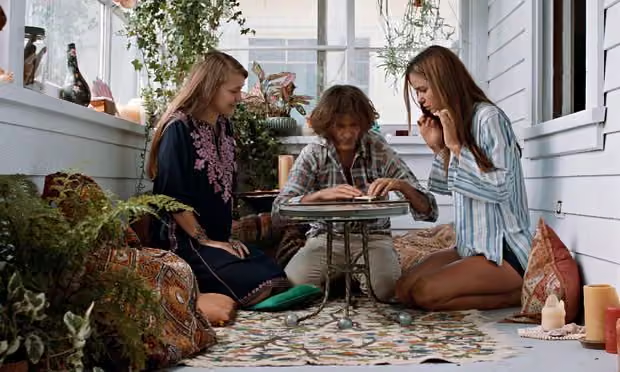
Paul Thomas Anderson turns his attention to a period drama involving high fashion in 1950’s London. The hype for this film was electric with much of the buzz revolving around Phantom Thread being the swansong for method acting master, Daniel Day-Lewis. Anderson’s previous efforts centre on dreamy Californian landscapes, but here he swaps the American Dream for a film that captures the essence of the time, indulging in the opulence that the characters live with.
Day-Lewis shines as Reynolds Woodcock, a renowned classically trained fashion designer who finds himself lost for inspiration. He soon finds it in his muse, Alma (Vicky Krieps) who almost becomes a lifeforce for Woodcock as his creativity is sparked.
On the surface, the film explores the flight and fancy of high society in 1950’s London but beneath lies a darker world of manipulation, the unwavering quest for perfection and the consequences this has. The film is a love story but underneath the romance lies something much darker.
Reynolds is controlled by his watchful sister, Mabel (Lesley Manville) who openly dislikes Alma who controls Reynolds by poisoning his tea with wild mushrooms. It’s an endless cycle of creativity and struggle to maintain that inspiration. He survives and thrives on that perfect idea but when it fails or runs out, it physically and mentally takes its toll.
Alma is an interesting character because the world she comes from clashes drastically with Reynolds. Having worked as a waitress previously, she is thrust into the spotlight and into the eye of high society. She fits the role physically with ease but the emotional impact the societal expectations and, more important, Reynolds expectations have on her makes for some intense encounters. Manville also lights up the screen as Mabel and her character is blunt and brash but her job is to keep the standards high. She is the constant as Reynolds wavers from high to low and high again.
Mabel’s presence is not only exciting but necessary to the friction between the characters as her treatment is consistent and her unapologetic way in demanding respect from Reynolds in particular is exciting as we rarely see a woman so equally challenging and empowering.
Phantom Thread has a moodiness that is exacerbated by a luscious colour palette. Some scenes are reminiscent of the longing and melancholy of Edward Hopper’s painting with its character-driven focus. It is a film that thrives on the reaction rather than the actions that happen.
If ever there was a director bold enough to take on an adaptation of postmodern behemoth Thomas Pynchon, it’s Paul Thomas Anderson. Inherent Vice is based on the 2009 novel of the same name set in 1970s California. Anderson sets himself a difficult challenge as the first (and still only!) person to adapt Pynchon for the screen. Remarkably enough, he even received Pynchon’s support which is incredible considering how much of a recluse the author is.
Inherent Vice is the most straightforward text as far as plot and setting goes as the focus on a singular character, Doc Sportello (Joaquin Phoenix) makes the film more accessible than say Gravity’s Rainbow which has hundreds of named characters. Phoenix delivers another knockout performance as the aloof Sportello, a drugged out cop trying to find his missing ex-girlfriend, Shasta (Katherine Waterston).
Waterston is the “find” of the film, gaining her mainstream breakthrough with her portrayal of Shasta Fay Hepworth. While other characters including Doc and Lieutenant Christian F. “Bigfoot” Bjornsen (Josh Brolin) are larger than life caricatures, Shasta is the heart of the film and acts as its emotional anchor. Not only does Waterston hold her own against Phoenix’s transformative performance, but her presence is felt throughout the film, despite only being onscreen for around 15 minutes of the film’s 148-minute runtime.
The score is provided by longtime collaborator, Jonny Greenwood who taps into the mystery elements of the plot. While the songs on the soundtrack emphasise the uplifting hazy dreamland of hippie California, Greenwood’s score brings a darker edge with lovely motifs that linger and repeat throughout the film. The “Shasta” tracks are wonderful, getting longer and more complicated as the film goes on.
As a fan of Pynchon and the novel in particular, I understand why this one was picked to adapt out of all of them as he’s not a writer for the light-hearted. Even after the unique use of syntax and whirlpool of characters, he introduces drug-fuelled ideas that only make relative sense once you allow yourself to be fully immersed in the text.
The unfamiliarity of the source material can be off-putting for some, but it’s a great film with a brilliant script. A highly underrated film, it’s not one to underestimate.
The Big Kahuna. The game changer. The film that made Anderson a solidified mainstream beast of cinema. There Will Be Blood takes its inspiration from the novel Oil! by Upton Sinclair and follows Daniel Plainview (played magnificently by Daniel Day-Lewis) and his climb to the top during the Southern California Oil Boom.
The film is set in the late 19th century and is a seemingly traditional retelling of the American Dream but as with any PTA, not all is as it seems.
Quickly Plainview’s ambition is replaced with cruelty, deception and manipulation particularly in the relationship deterioration with his son, H. W. Plainview (played by Dillon Freasier and Russell Harvard as child and adult H. W., respectively) and the mistreatment of local preacher/proclaimed prophet, Eli Sunday (Paul Dano who also plays Eli’s twin brother, Paul Sunday).
Winning Day-Lewis a second Best Actor Oscar (my favourite Day-Lewis performance) and featuring a career smash for Dano, Anderson shows his control and maturity as a filmmaker with this one. Masterpiece is a term often thrown around meaninglessly but it is more than justified here.
It’s a shame that it was up against the Coen Brothers’ offering, No Country for Old Men, as it lost out on several deserved Oscars. Not to say No Country for Old Men shouldn’t have won but I personally prefer There Will Be Blood due to how well-realised Plainview’s character is while the direction is as slick as the oil they drill.
Punch-Drunk Love is Paul Thomas Anderson’s take on a romantic comedy, but still maintains his signature absurdity and intricacy. Following a more streamlined narrative and a smaller cast of characters, Punch-Drunk Love is a 90 minute whirlwind.
Whoever says that Adam Sandler has never turned in a great performance has never seen this gem of a film. Sandler plays Barry Egan, a depressed businessman who owns a company selling novelty items such as toilet plungers. He has seven sisters who constantly ridicule and abuse him, making fun of his shortcomings and inability to find a fulfilling relationship. He meets the elusive Lena Leonard (Emily Watson), who works with one of sisters and the two get on well with relationship between them soon blossoming.
Soon enough, Barry finds himself engaged in a slew of unfortunate events when a sex-line operator extorts him and demands the collection of a large sum. He tracks down the manager of the sex-line and finds mattress store owner, Dean Trumbell (Philip Seymour Hoffman). His interaction with Dean is interesting because it is Barry’s vulnerability and sensitivity (which are often perceived as “feminine” traits) that actually intimidate Dean.
What Anderson presents us with is a complex insight into masculinity and femininity and the societal expectations that are held for both. Barry and Lena are ostracised because they openly hold traits in both and reject the norm. Lena is a successful travelling businesswoman.
The final act of the film sees Barry agree to openly support her, subverting the stereotypical gender norms. However, it isn’t done to show a sign of weakness in the relationship but rather Anderson concluding that their relationship is stronger because of their differences and unwillingness to fit in.
Commonly remembered as Paul Thomas Anderson’s epic, Magnolia is 3 hour saga follows the seemingly isolated lives of various characters and their eventual biblical crossover. Building on the legacy of Boogie Nights by incorporating more stars and more stories than its predecessor.
Set in LA, we follow the day of a policeman who finds a body in a closet, a terminally ill gameshow producer and a child progeny who is set to compete on the gameshow while suffering from abusive parents behind the scenes.
The cast features Anderson regulars such as Philip Seymour Hoffman, Julianne Moore and John C. Reily but also brings a wider cast led by Tom Cruise who brings an energetic and charismatic performance as motivational speaker, Frank T.J Mackey and Jason Robards as the ailing gameshow producer, Earl Partridge.
Magnolia tends to split critics and the audience due to its melodramatic feel and long running time but these aspects are justified and adds to its uniqueness. It’s seemingly ingrained in its own reality but this is turned on its head with the iconic scene in which frogs suddenly fall from the sky.
The film takes its audience through the full spectrum of emotions. Anderson wants us to feel uncomfortable and confused at times. It is centred around human nature and the emotions within that.
Boogie Nights marked Paul Thomas Anderson’s cinematic breakthrough with his pitch perfect observation on the porn industry in 1970s Los Angeles. We follow Eddie Adams (Mark Wahlberg), a high-school dropout who has a chance encounter with porn producer, Jack Horner (Burt Reynolds) who propels him into the spotlight of adult film under the moniker, Dirk Diggler.
The film brings drama, light comedy, acting legends, newcomers, movie magic and gritty realism which is interweaved into a large spiderweb that is just as complex as the mind. It is a colourful insight into the human condition and the lengths that a person will go in order to retain their legacy.
The cast is as starry as the Hollywood lights with Reynolds, Julianne Moore, Don Cheadle and Philip Seymour Hoffman being the standouts for me (the number of standouts shows just how star-studded this film is!). Boogie Nights brought two of its cast, Reynolds and Moore Academy Award nominations and gave Anderson his first Best Original Screenplay nomination.
It would be easy for a film about the porn industry to turn into a gratuitous portrayal from a male gaze but Anderson is mindful not to fall into this trap.
The film is not made to be aspirational or shaming and provides a more factually based and neutral perspective. The wonderful thing about Anderson is that he doesn’t patronise his audience and encourages the audience to draw their own interpretations from the film.
Indeed, by viewing Boogie Nights a simple flick on the porn industry would be to miss the underlayer that explores tragic themes such as the American Dream as a lie, female oppression, misogyny and racism.
Hard Eight marked Paul Thomas Anderson’s feature debut, providing a strong start to a lengthy career that has seen masterpiece after masterpiece over the last three decades. Despite being made on a small budget, Hard Eight boasts an incredible cast including John C. Reilly, Gwyneth Paltrow and Samuel L. Jackson.
The film follows Philip Baker Hall as gambling addict, Sydney Brown who comes across a younger man, John Finnegan (Reilly) who has lost all his money gambling. Sydney is sympathetic and take John under his wing and the two begin a successful gambling duo.
Philip Seymour Hoffman also stars in a small role as a craps player which is always welcome, particularly in an Anderson film, and proved to be the start of a great collaborative process for the two in future projects.
Compared to what would follow, the plot is simple with the focus being kept on a small number of characters that follow limited plotlines. It isn’t a film that is challenging if compared to Anderson’s other offerings in the future but it is still a profound film that explores themes such as vulnerability in masculinity, brotherhood and greed in capitalist America.
Hard Eight is a great film that shows off Anderson’s skill as a writer with a distinctive vision and the fact that his filmography only improves after this is a credit to that talent.
Paul Thomas Anderson is one of the best directors working today because you never know what to expect with each film and One Battle After Another is no exception. Heralded as the best film of the year so far by numerous outlets, One Battle After Another is an unnerving portrait of the current political landscape, as far-right militia crack down on illegal immigration sparking violent protests from the far-left revolutionary group, the French 75. The film follows paranoid drug addict, Pat Calhoun (Leonardo DiCaprio), who must tap back into his French 75 training when his daughter, Willa (Chase Infiniti), is being hunted by the corrupt Colonel Steven J. Lockjaw (Sean Penn).
Marking his second Thomas Pynchon adaptation, director Paul Thomas Anderson lifts the basic plot of the novel, Vineland, from its Reagan-era setting and brings it to the 21st century. The result of which is an unpredictable study of political and socioeconomic conflicts in America that bubbles in tension as it interweaves characters meticulously until the fiery climactic third act. The fusion of Pynchon’s psychedelic wasteland and Anderson’s sharp attention to detail pushes One Battle into a league of its own and ultimately brings us a new kind of “epic” movie: one that is doused in dystopia nostalgia and intricate character dynamics.
Leonardo DiCaprio proves yet again why he is one of the best leading men in Hollywood. He is a tour de force as paranoid, drug addict, Pat Calhoun, a former bomb expert for revolutionary group French 75. Having worked with Martin Scorsese on a third of films released this century so far, DiCaprio has become synonymous with the realist gritty roles expected from a Scorsese feature. However, we’ve also seen DiCaprio venture into unfamiliar territory with highlights including his turns in Quentin Tarantino’s films Django Unchained and Once Upon a Time in Hollywood. However, it’s this performance as hopeless Pat that feels the most realised and distant from DiCaprio’s tenure in the 90s. We’ve seen him shine in comedies before with Wolf of Wall Street often cited as the film that should have won him the Oscar, but there is a tenderness in Pat’s character as he tries to do the right thing and constantly fails. His instincts fail him as he raises his daughter, Willa (Chase Infiniti) as a single parent following the abrupt departure of his partner, Perfidia Beverly Hills (Teyana Taylor) and spends his days drinking and getting high. You could argue that Pat’s character is cut from the same cloth as Joaquin Phoenix’s Doc in Inherent Vice. Both characters are conceptualised by Thomas Pynchon and realised by Anderson, but it goes beyond the aesthetic and feel of the great days of old. Pat and Doc both strive to create a better world, but in doing so find themselves against the sheer corruption of government, leading to a headfirst leap into conspiracy followed by drug-fuelled madness. Pat may seem cartoonish to an extent, but the sincerity with which DiCaprio plays him and that unkillable urge to better the world is the driving force that allows the film to deliver it’s message flawlessly.
In true PTA-style, we have a supporting cast of eccentrics with the standout being Sean Penn as the corrupt Colonel Lockjaw. Penn’s performance is so over the top with his physicality and mannerisms, that it’s hard to take Lockjaw seriously. Often used as the butt of a joke or the punching bag for the sinister Christmas Club, you can sense that Lockjaw is being pushed to his limit. We see flickers of darkness throughout the film, but it is during the final act when we see Lockjaw’s true nature and Penn brings the monstrous side of Lockjaw brilliantly. I don’t doubt that Penn will receive nominations across the board with a big chance of sweeping. This feels like a comeback in a way as Penn is extremely selective with his roles, but hopefully we can see more PTA collaborations in the future.
Another phenomenal supporting turn is from Benicio del Toro, who plays Pat’s friend, Sensei Sergio. He is viewed as a de facto leader in the immigrant community, always striving to help those in need. Once he realises Pat’s past affiliations, Sensei endeavours to help any way he can, understanding that their core values align. The opposite of Lockjaw in every sense, del Toro’s performance is minimalist and subtle but holds the same amount of impact with less time than Penn. With so much shine on Penn’s performance, it would be remiss to overlook the astonishing work del Toro does here and he more than deserves inclusion in Best Supporting Actor discussions.
There’s nothing better than seeing someone absolutely smash their breakthrough role and Chase Infiniti’s performance as Willa is among the best in recent years. Not only does she hold her own against industry veterans with ease, her performance brings the heart to the film. We see Willa try to break free from her father’s restrictions with success and failure in equal measure. Despite growing up in a community that society would deem “outcasts”, Willa herself is seen as an outsider to her peers, making her an isolated individual. The main frame of the film sees Willa come to terms with her identity and the mystery of her mother’s whereabouts and how that legacy determines her place in the world. It could be argued that One Battle is a coming-of-age film as Willa’s “battle” is building her own identity as she enters adulthood.
Jonny Greenwood returns to score the film, bringing a 1970s soft-rock vibe that feels nostalgic and scenic. As expected from Greenwood’s work with PTA, the music works with the imagery, masterfully layering sounds to build tension which contrasts with the quieter music during scenes with lots of dialogue. There is a timeless quality to Greenwood’s score, despite its 1970s-inspired sound. At times mellow with vast scenery while at others, jaunty and infused with espionage during protest scenes, Greenwood finds a dynamic balance that is offbeat and complimentary at the same time.
If Greenwood’s score is the fire then Michael Bauman’s cinematography is most definitely the match. The use of wide shots that linger elevates the suspense and unpredictability of the film. We, the audience, can only sit and watch these events unfold with an unflinching and unfiltered perspective. Bauman manages to use open spaces in a way that feels awfully claustrophobic. No matter whether the characters are meandering round the desert or huddled in tiny interrogation rooms, there is always a sense of entrapment that allows for no escape. The use of the camera when Willa is driving up and down hills with plenty of blind spots is nail bitingly brilliant and fully immerses the audience into the uncertainty of where the road – literally and figuratively – will lead.
One Battle After Another may just be the film that gets Paul Thomas Anderson his well-deserved moment of glory after decades of impeccable output. One Battle is a searing commentary on contemporary America and thanks to a plethora of memorable performances, an impactful score and ingenious cinematography, this is definitely a film that demands repeat viewings.
One of the most critically acclaimed films to come out of 2021 is Paul Thomas Anderson’s newest release, Licorice Pizza. The film follows the unlikely meeting of teenager actor, Gary Valentine (Cooper Hoffman) and photographer assistant, Alana Kane (Alana Haim) and the subsequent turbulent relationship that develops between them. Although Gary and Alana have very different backgrounds, they both have passion and ambition to better themselves and it is this drive that they have that leads into their adventures and the events of the film. Anderson’s ability to create fully-rounded characters that have talents and flaws is what makes Licorice Pizza so captivating.
As expected of an Anderson film, Licorice Pizza is filled with well-written characters, a character-led storyline and is beautifully directed. However, Licorice Pizza has not been without controversy thanks to the age gap between the protagonists with Gary being 15 and Alana being 25, especially as their relationship begins to grow closer. The age gap does make Licorice Pizza uncomfortable to watch at times because Gary is underage. However, as with any Paul Thomas Anderson film, there is much more going on aside from the protagonists relationship. We see Gary and Alana’s separate personal lives and thr colourful characters that they encounter such as Jon Peters (Bradley Cooper) and a heartbreaking storyline with local politician, Joel Wachs (Benny Safdie). Anderson’s eclectic mix of real characters, characters based on real people and fictional creations helps to create a California that is true to his style and vision.
Alana Haim has proven herself to be one of the standout newcomers of 2021. She has already shown that she is an incredibly talented musician as she is a member of the band, Haim with her two sisters who play her sisters in the film as well. What makes Haim such a joy to watch is the charisma that she brings to the character. We don’t always understand Alana’s choices and may not agree with them, but there is something about Haim’s performance that keeps the audience watching. We feel the frustrations that Alana has as she deals with a bunch of kids that don’t have the same understanding of the world as she does, while simultaneously finding herself overwhelmed by the pressures from the older generation. Alana simply wants to find a place where she belongs and her journey leads her to Gary. She knows that embarking on a relationship with Gary is wrong due to his age, but she is constantly drawn back to him. Her attempts to reject her feelings fail as she finds herself in harm’s way while on a date with actor Jack Holden (Sean Penn) while differing religious beliefs get in the way of her blooming relationship with Lance (Skyler Gisondo).
To play the role of Gary, Anderson bestowed the task upon Cooper Hoffman, son of the late great Philip Seymour Hoffman. Marking his film debut, Hoffman proves that he has what it takes to not only lead a film, but to do so with the charisma and charm that feels resonant of his father’s work. Gary is a confident character and adamant that he knows what he wants. In the film’s opening scene, we see him meet Alana and tell her that she is the love of his life. Despite only being aged 15, Gary’s life is filled to the brim with adult responsibilities. He is an actor and businessman, running a waterbed business and a pinball arcade during the film’s timeline. It’s easy to forget that the character is only 15 due to the high levels of responsibility and common sense that he has. On the other hand, he is extremely naive and believes that the world revolves around him. Anderson’s decision to have both protagonists played by newcomers is incredibly smart as they bring that starry-eyed ambition to the roles that perhaps a veteran would not have been able to do.
Paul Thomas Anderson’s films are known to be filled to the brim with stars and although he has newcomers in the leading roles, he makes sure that he has an A-list cast in support. The highlight of the supporting cast is Bradley Cooper as Jon Peters in what is a deeply unsettling and neurotic performance that captures Peters’ unpredictability perfectly. From the moment he appears on the screen, the tone of the film instantly shifts as he is deeply threatening in delivery while masking his threats in comical analogies and metaphors. The entire storyline that involves Peters is the best sequence in the film and this is thanks in part to Cooper’s intense portrayal.
Jonny Greenwood returns for his fifth collaboration with Paul Thomas Anderson and as expected, it is fantastic. Unlike other Anderson films, Licorice Pizza is dominated by songs from the 1970s in its soundtrack and doesn’t utilise Greenwood’s score as much. When we do hear Greenwood’s tracks, he takes advantage of the romantic undertones of the story as the music is filled with the longing that the characters have for each other. 2021 has been a busy year for Greenwood as he has also composed the music for Spencer and The Power of the Dog and it’s amazing to hear how different each soundtrack is while managing to maintain his own identity throughout.
There are aspects of Licorice Pizza that feel uncomfortable at times, primarily the age gap between the protagonists and the way their relationship is portrayed. However, there is no denying that the film is beautifully shot and is filled with fantastic performances, especially from Alana Haim and Bradley Cooper. Licorice Pizza is a nostalgic nod to 1970s California and transports us to the world behind the scenes of Hollywood in a way that hasn’t been done before.
What did you think of Licorice Pizza? Let me know in the comments below!
I have said this once and I will say it again. When Adam Sandler puts his mind to it, he can turn out a star-studded performance that most dramatic actors can only dream of. He did it in Paul Thomas Anderson’s 2003 Punch-Drunk Love and he’s done it again in the mind-warping Uncut Gems, directed by Josh and Benny Safdie (commonly referred to as the Safdie Brothers). Following Howard Ratner (Sandler), the owner of a luxurious jewellers in the Diamond District in New York and his inability to function as a normal human would. Crippled simultaneously by debt and a gambling addiction to boot, Howard is an awful human being and the Safdies make this no secret. The audience isn’t supposed to like him and yet we do because he is charismatic and pathetic at the same time. When a priceless gem is delivered to him and loaned to basketball star Kevin Garnett, Howard finds himself on the brink of self-destruction as he struggles to get the stone back and at the auction house where he expects to earn millions. Produced by powerhouse studio A24 and distributed on Netflix, Uncut Gems is the film equivalent of an anxiety attack thanks to the unrelenting actions of its protagonist who doesn’t know how to relax. Featuring a variety of celebrity cameos including The Week’nd, Tilda Swinton and Natasha Lyonne, there is also a strong supporting cast led by Lakeith Stanfield as Howard’s assistant, Demany and Julia Fox as Howard’s girlfriend, Julia.
The Safdie Brothers’ vision comes across brilliantly on the technical side. Known for their collaborations with Ronald Bronstein who cowrote the script with both Safdies and also co-edited the film with Benny Safdie. This is a film that needed more than one mind behind the vision and the result is crisp and sleek. The writing is sharp and to the point which is crucial as there are many characters and plenty of scenes in which lots of characters populate the screen. It’s a film that benefits from its direct nature meaning that there are few speeches and little emotion. When the film does delve deep into serious emotion, it feels almost disingenuous because the characters are so self-absorbed. It is the deeply flawed characters that gives the film its grit. What I love most about this film is how fantastical it feels in terms of the tone as Howard lives a luxurious life and yet the violence he is exposed to grounds the film. There is a disconnect between the life Howie should have and the life that he does have. Despite his wealth, he is constantly viewed as an outsider for a multitude of reasons. One such reason is his Jewish faith which is constantly remarked on by his clientele, friends and those he deals with when betting. Another such reason is his inability to maintain sustainable relationships. His paranoia overtakes his love for Julia because he cannot truly fathom that a woman like her could truly love a man like him. His insecurity is a constant throughout the film and is the main reason for his instability.
Adam Sandler is nothing short of brilliant in this film and should have been nominated for all of the awards including the Oscar. His performance is manic and seems lucid but the amount of work Sandler put into this character is clear. Howard is deeply complex. He is fully aware of his issues and yet doesn’t do anything about them. The film is constantly moving up and down as Howard’s rollercoaster way of living reflects the wins and losses he experiences in gambling. This film has become instantly quotable with gifs and memes flooding the internet. Howard’s sleaziness only adds to his dark humour and helplessness. The film is from Howard’s perspective meaning Sandler is onscreen for the vast majority of the film’s 135 minute running time. What makes the character of Howard so hypnotic and engaging to watch is that he acts like an unreliable narrator at times. We hope he pulls through but at the same time his flaws often outweigh his strengths. The climactic scene in which Howard is watching the final basketball game that he has bet all of his earnings on is deeply intense and yet he seems relatively calm. His certainty that he will win when his first bet was reliant on a coin toss is unbelievable. If there was an award for the most frustrating character in film history, Howard would definitely be up there but that is exactly how he is meant to be. He is one of the most unlikeable likeable characters I have ever come across and I think it’s credit to Sandler’s skill that he manages to pull that off.
The score provided by Oneohtrix Point Never is a showstopper. The tone that the score gives is in a similar vein to Jóhann Jóhannsson’s brilliant score for the 2018 film, Mandy. Much like Jóhannsson’s score, Oneohtrix Point Never’s score has also proven divisive but I think that Uncut Gems is a film that doesn’t hold back in its performance, script and subject matter. The music is futuristically nostalgic, merging various genres and sounds to create a soundtrack that is unique. Much like the protagonist, the score doesn’t seem to settle and keeps crashing through, heightening the tension and making for an anxiety-ridden audience experience. The score category in awards season was very strong this year but I still think it was a shame that the Uncut Gems soundtrack wasn’t at least recognised. The fact that it clashes with what you see on the screen adds to the jarring effect that the film brought.
Uncut Gems lives up to the hype and delivers brilliance in spades. It’s a shame that it wasn’t recognised this awards season but I believe that Sandler’s performance specifically will not go unnoticed. If anything, Uncut Gems has opened the door for Sandler to continue tackling challenging roles and it makes me excited to see what the Safdie Brothers have planned next. It’s a film that isn’t afraid to make light of the dark topics it explores such as addiction and violence. It’s reluctance to fit into a specific box of film makes it a stand out in the same way that Parasite is and I think it was stronger than a lot of contenders this awards season.
What did you think of Uncut Gems? Let me know in the comments below!