Categories
Uncategorised

Marielle Heller: Film Ranking

Marielle Heller is one of the most exciting filmmakers working in the industry. Although she is not a household name in the mainstream yet, she has proven her talent and range in the three feature films she has directed so far. All three are adaptations of different mediums which also shows Heller’s skill as a writer. Starting with The Diary of a Teenage Girl in 2015 thrust Heller as an emerging writer/director thanks to its controversial and unflinching portrayal of its subject matter of underage sex. Following this, Heller made a dramatic star out of comedienne Melissa McCarthy in biopic Can You Ever Forgive Me? in 2018 followed by 2019’s A Beautiful Day in the Neighborhood which follows a journalist writing a piece on American icon, Mister Rogers. Her absence from major award nominations has been subject to controversy with stars such as fellow director Greta Gerwig and Natalie Portman using their platform to promote her work.

Here are my mini reviews and rankings for the films by Marielle Heller:

The Diary of a Teenage Girl (2015)

Heller’s debut is the perfect scene stealer opening up with 15 year old Minnie (Bel Powley) walking in the park with her confident voice over stating “I had sex today. Holy shit!” Heller’s script and direction follows Minnie from a distance allowing her life to play out with the complicated relationships she has with her mum, Charlotte (Kristen Wiig) and Charlotte’s boyfriend, Monroe (Alexander Skarsgård). Powley’s breakout performance is nothing short of perfection. She comes across as confident and all-knowing, even recording audio diaries. Based on a hybrid novel combining novel and graphic novel by Phoebe Gloeckner. Minnie winds up in a sexual relationship with Monroe and believes she is in love blind to the realities of the situation. As the affair goes on, Monroe is dismissive of Minnie’s satisfaction and is aware what he is doing is wrong. The film is a unique look into the sexual mistreatment of women and girls and how society expects them to act in order to satisfy the patriarchy. It is a film about personal and emotional growth with Minnie eventually learning to become independent and satisfied in herself and her talents as an artist. Despite her flaws and mistakes, she thrives above what society thinks of her and does what makes her happy.

Can You Ever Forgive Me? (2018)

Heller’s follow-up Can You Ever Forgive Me? is based on the 2008 memoir of the same name by writer Lee Israel. Following Israel (Melissa McCarthy) as she forges letters written by famous writers and sells them off to earn extra money, Can You Ever Forgive Me? is a film about the writer and artist desperation. At the beginning of the film, Israel is experiencing a career slump, unable to secure an advance for her book and is forced to sell her possessions to pay her bills. What starts from selling a personal letter from Katharine Hepburn spirals into forging letters from celebrities with scandalous details. Enlisting the help of her friend, Jack (Richard E. Grant), the two begin stealing letters from libraries and archives as well as forging other letters. McCarthy and Grant bring career best performances and earned them Oscar nominations for Best Actress in a Leading Role and Best Actor in a Supporting Role (Grant’s first and, to date, only Oscar nomination!).

A Beautiful Day in the Neighborhood (2019)

One of my favourite films from last year, this underrated gem stars Tom Hanks as American treasure, Mister Rogers and features Matthew Rhys as a skeptical reporter who is asigned to write on Rogers. I have written a longer review for A Beautiful Day in the Neighborhood here which you can read. Bringing Tom Hanks his first Oscar nomination in years, A Beautiful Day in the Neighborhood utilises wonderful puppetry in a film that is heartwarming with a deep message. Among a film landscape that is full of fear and dread, it’s nice to see a film about kindness and love being made.

Each film has its strengths and they are all so different which makes it difficult to rank them even though there are only three. Here is my ranking for Heller’s films:

1) The Diary of a Teenage Girl

2) A Beautiful Day in the Neighborhood

3) Can You Ever Forgive Me?

I really recommend giving each of these films a viewing at least once. Heller has a knack for drawing out brilliant and unexpected performances in films thay serve as flawless examinations of its characters.

Have you seen any Marielle Heller films? Which ones are your favourites? Let me know in the comments below!

Categories
Uncategorised

The Wizard of Oz (1939)

With the hype of awards season in full swing, I thought I would take a look back at some older favourites of mine. Inspired by the Judy Garland biopic, Judy, what better way to connect the current awards season with a favourite classic of mine and discuss the wonderfully magical The Wizard of Oz (1939). Commonly seen as the film that propelled Judy Garland to stardom at the tender age of 16, cementing her legacy in Hollywood for years to come. The film is adored by fans of all ages and a regular watch at Christmastime. Following Kansas teen Dorothy Gale who is whisked away in a tornado along with her dog, Toto and landing in the mysterious land of Oz. Dorothy must team up with the unlikeliest of friends and find the great Wizard to find her way home. The film was mainly directed by Victor Fleming who left the production to direct Gone With the Wind and the remaining work was taken over by King Vidor. The screenplay was written by Noel Langley, Florence Ryerson and Edgar Allan Woolf and based on the classic children’s book The Wonderful Wizard of Oz by L. Frank Baum, The Wizard of Oz is a masterclass in classic Hollywood cinema.

Judy Garland is absolutely breathtaking as Dorothy. Probably one of the most perfect casting choices in film history. From her brilliant expressions and sheer talent for being an all-rounder, it’s hard not to feel moved by Garland’s performance, particularly when she sings “Over the Rainbow”. Garland’s background and the tragedy behind her experience filming this is well-known. The trauma Garland went through during the filming was sure to have had a lasting effect on her for the rest of her life. This makes the performance even more heartbreaking watching in retrospect. Dorothy has enough bravery and courage to face her enemies and stand up for herself but there is still vulnerability there and a maturity that makes her seem older than her years while at the same time bringing in that childlike innocence.

In terms of the supporting cast, the most iconic comes in the form of Margaret Hamilton’s brilliant turn as the Wicked Witch of the West. She’s just a plain nasty character and her only motive is ensuring that Dorothy doesn’t succeed in her quest. Hamilton’s voice and characterisation is a performance of legend and has resulted in one of the most identifiable villains in film history. Whether it is one of her trademarks such as “I’ll get you, my pretty, and your little dog too” to the iconic melting scene in which we see the Wicked Witch defeated after Dorothy throws a bucket of water over her. Out of the three friends, my favourite is the Cowardly Lion (Bert Lahr), mainly because I love the costume design so much and his performance of the song “If I Were King of the Forest”. It’s a film that is rich in distinguished characters that, although simple, does a good job of giving them enough screen time to be distinguishable.

I don’t know where to begin to talk about my love for the use of colour in this film. Aside from being iconic thanks to its amazing switch from black and white to brilliant technicolour with the simple opening of a door. There is so much to look into beyond Kansas representing the normal and dreary everyday and Oz being somewhere completely different. The location and setting for Kansas is natural with realistic looking prop whereas Oz is crammed full of fake creations. Munchkinland in particular is the epitome of the Oz aesthetic. It makes for a fantastically striking entrance into the land of Oz. Maybe it’s because we’re adjusted to the black and white set up that makes the colour pop out the screen even more, the design of Oz is truly spectacular. Also, the use of colour for the characters is beautifully done. From the contrast between the ruby red slippers that Dorothy wears with the Wicked Witch’s green skin and the metallic hue of the Tin Man’s paint with the Cowardly Lion’s golden mane. Oz is a land that although entirely built from imagination, also includes a multitude of texture.

I’ve already touched on the music before but it deserves a section on its own. The film is crammed full of brilliant songs that have stood the test of time. Undoubtedly, “Over the Rainbow” is the most popular but most people would also be able to sing or hum along to the likes of “Ding-Dong! The Witch is Dead” and “If I Only Had a Brain”. It is undeniable that Garland’s voice is beautiful and flawless, striking the perfect amount of emotion in her songs. Looking through the soundtrack, it is amazing to think that so many songs have gone down in cinema history as classics. A lot of the legacy from The Wizard of Oz comes from its Academy Award winning score by Herbert Stothart. Not to forget that “Over the Rainbow” also won the Oscar for Best Original Song for Harold Arlen and Yip Harburg. It’s a whimsical soundtrack that allows its audience to escape to Oz with Dorothy.

I am sure given that I love films like Snow White and the Seven Dwarfs and The Red Shoes that I am just as fond of this one. The Wizard of Oz is an outstandingly beautiful cinematic achievement and a prime example of a film that is suitable for all ages and all cinematic tastes. It is a film that combines drama, comedy and musical while also not fearing to delving into themes of loss and friendship. Dorothy is ultimately on a journey to finding out who she is and discovering her place of belonging. It’s this relatability that makes the film so identifiable with audiences around the globe.

What do you think of The Wizard of Oz? Let me know in the comments below!

Categories
Uncategorised

The Tale of the Princess Kaguya (2013)

My favourite animation of the past decade hands down belongs to Isao Takahata’s swansong which is a retelling of the Japanese folktale “The Tale of the Bamboo Cutter”. It follows a man who finds a small girl in the centre of a bamboo shoot, he picks her up and she turns into a baby and then quickly grows into a young woman in the blink of an eye. Known as Takenoko (which translates as “Little Bamboo”), the family live a life filled with finery. Takenoko is given the title Princess Kaguya and soon begins the quest to find her a husband. The only problem is that Kaguya does not want a husband. She enjoys her freedom and finds the concept of regality to be horrifyingly restrictive. The film underperformed at the box office but the critical response is overwhelmingly positive with five stars across the board. It’s a shame that this film hasn’t received the mass audience that Spirited Away did because it is such an intricate look into traditional Japanese culture whilst merging in the pressures of being a woman in a man’s world and living up to societal expectations. Its portrayal of depression is one of the most realistic and resonating in film for me, particularly the scene in which Kaguya flees the party and sheds her many kimonos. The significance of this scene cannot be discussed enough. Kaguya is dismissing the life that her parents have decided for her. Her parents are not bad people but they have confused their own wishes with their daughter’s and this is what ultimately tears the family apart. The film was released just after Hayao Miyazaki’s The Wind Rises in a double bill that hasn’t been seen since the 1988 releases for My Neighbor Totoro and Grave of the Fireflies. Just as those films are completely different in subject matter and style, the same could be said of The Wind Rises and The Tale of the Princess Kaguya.

The animation style in this film is what makes it instantly stand out in the Ghibli catalogue. Taking clear inspiration from traditional paint and ink, it veers away from your typical Ghibli and Takahata aesthetic but the result is a beautiful use of technique and colour. It feels as though the film is a fairy-tale jumping from the pages of a book. The pastel colour scheme contrasts beautifully with the strong black strokes. This truly is art in animation and a testament to Takahata’s ability to push the envelope. The film in its entirety is beautiful but the now iconic cherry blossom scene is one of the most wonderful sequences in any film. Kaguya runs and plays as the cherry blossoms fall and the result is a scene of joy and freedom. The mix of deep black outlines filled in with delicate hues of pink are simplistic but resonate the lightness and happiness that the character is feeling. The use of colour is so important in this film as it evokes both material and figurative richness. Contrast the colours of nature as Takenoko ventures in the forests as a child which excites her with the scene in which she is gifted numerous kimonos that are made of unnatural colours in rich jewel tones. Takenoko is taken aback by the gift and loves playing with the material in a scene which is just as beautiful as the cherry blossom scene.

princesskaguya1

The character of Princess Kaguya herself is deeply complex and despite her origin as a being from the Moon, is one of the most human characters brought to film. Her journey from bamboo spirit to fully fledged Princess is turbulent and challenging. Content with the humble lifestyle her Earth parents lived before inflicting delusions of grandeur upon her, Takenoko refutes the lifestyle expected of a lady in high society. She is trapped within the walls of her mansion within the city and longs for the wilderness and freedom it brings. The character is not without her flaws. She purposefully manipulates five potential suitors to cross oceans and collect tokens for her affection. She does this knowing that she doesn’t care for any of them and knowing that it isn’t possible to gain these mythical gifts. When falling into her depression, we feel for her because she doesn’t want to let her parents down and appreciates everything they have done while at the same time sacrificing her own happiness. Ultimately, she has to ask herself if her parents happiness is worth exchanging for her own and asks for the Moon to reclaim her. Kaguya is a character who knows what she wants and this progressive outlook does not fit in within a society that has a place for her.

In an unusual move for Takahata, he recruited Joe Hisaishi to compose the music for this film. Hisaishi is known for his frequent collaborations with Miyazaki and had only just delivered a stellar score for The Wind Rises. It’s a credit to Hisaishi that he worked on these scores at the same time and yet both soundtracks have their own style and identity. The score for The Tale of the Princess Kaguya deeply lies in Japanese tradition, utilising traditional instruments such as the Koto which the titular character has a natural affinity for and whimsical woodwind that really brings you into the era and setting. Hisaishi has his own distinct sound as I have discussed in previous posts but this one feels totally unique in its approach. It feels softer and more ingrained in its tradition and heritage than other soundtracks. This could be because despite its fantastical elements, it is a film that is openly set in an ancient Japanese setting.

There are many scenes which stand out in this film for me and I have discussed a few of them in this post but the one that will remain the most heartbreaking is Kaguya’s return to the Moon. It’s a poignant sequence and one that will have you crying. When the procession of beings from the Moon come to collect Kaguya, the love that she has for her parents and vice versa flows through. It’s hard to believe that a children’s film can have such a sad ending but this is Ghibli and they are not afraid to delve into darker themes. Erased of her memories on Earth, Kaguya looks back at her parents and sees their love and smiles. This smile is bittersweet because she recognises the love that they have without understanding who the love is for and what it meant to them.

princesskaguya

The Tale of the Princess Kaguya is tied with Castle in the Sky for first place as my favourite Studio Ghibli film. It’s unlike any film you have ever seen and unlike any film you probably will see in the future. It’s a glorious achievement and worthy of being Takahata’s final film. The love and care that went into this film is so evident. I truly believe that the love for this film will grow in the coming years and it will become just as admired as some of the other popular Ghibli films in the catalogue such as My Neighbor Totoro and Spirited Away. It’s a film that is not an easy watch but it is so captivating and rewarding.

What do you think of The Tale of the Princess Kaguya? Let me know in the comments below!

Categories
Uncategorised

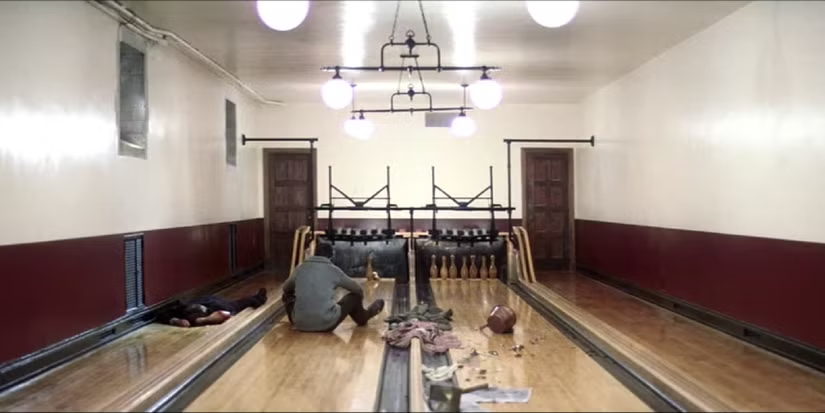
Paul Thomas Anderson: Film Ranking

Paul Thomas Anderson is known for his experimental and fearless quest into exploring characters in ways that are unflinching and at times, uncomfortable.

With the exception of last place (I really struggle with the age-gap in the relationship), I’ve watched these films multiple times and some of them are among my favourite films of all time.

Here’s my ranking for the filmography of Paul Thomas Anderson:

  1. The Master (2012)
  2. There Will Be Blood (2007)
  3. One Battle After Another (2025)
  4. Boogie Nights (1997)
  5. Phantom Thread (2017)
  6. Magnolia (1999)
  7. Inherent Vice (2014)
  8. Punch-Drunk Love (2002)
  9. Hard Eight (1996)
  10. Licorice Pizza (2021)

Which PTA film is your favourite film? Let me know in the comments below!

Categories
Uncategorised

The Lord of the Rings Trilogy (2001-2003)

Continuing on in my Favourite Film series, this post looks at the films that opened my eyes to filmmaking and made me realise my passion for film. Based on the huge novel by J.R.R Tolkien, The Lord of the Rings trilogy consists of Fellowship of the Ring, The Two Towers and The Return of the King and follows Frodo Baggins (Elijah Wood), a respected hobbit who lives with his adventurous Uncle Bilbo (Ian Holm) who is forced to carry the One Ring to Mordor where he must destroy it in the fires of Mount Doom before the evil Lord Sauron claims the Ring and uses it to rule over Middle Earth. Frodo is accompanied by the Fellowship that consist of his best friend, Samwise Gamgee (Sean Astin), fellow hobbits Merry (Dominic Monaghan) and Pippin (Billy Boyd), men Aragorn (Viggo Mortensen) and Boromir (Sean Bean), elf Legolas (Orlando Bloom), dwarf Gimli (John Rhys-Davies) and wizard Gandalf (Ian McKellen), Frodo must resist the lure of the ring and cross Middle Earth in a bid to save mankind from ruin. The trilogy also features a strong supporting cast with Hugo Weaving as elf Lord Elrond, Liv Tyler as his daughter Arwen who is Aragorn’s love interest and Miranda Otto in badass form as Éowyn. I know it seems a bit unfair to cram the whole trilogy in one post but it is impossible not to consider the vast achievement and scope that Peter Jackson has achieved.

It cannot be underestimated how well these films did upon release. The trilogy well surpassed the $1 billion mark and became instantly iconic around the world with masses of people en route to the premieres at their local cinemas. All three won big come award time with Fellowship of the Ring winning four Academy Awards, The Two Towers winning seven and The Return of the King sweeping the board with eleven nominations and eleven wins, tying with Ben-Hur (1959) and Titanic (1997) for the most wins at the Oscars. All three were critical and commercial smashes and boasted a spectacle despite being a film with fairly indie roots. It was different from other mainstream films because of this and I think the story’s message of fighting for good and friendship is one that resonates with a lot of people.

The cinematic releases see the films lengths at a minimum of 150 minutes per film but the extended editions bring the total running time an amazing 12 hours and what a 12 hours it is. The film achieved critical and commercial success upon release, has dated extremely well and remains one of the best loved franchises in history. Everything about it is perfect to me. I think it is a brilliant adaptation of the books and think the changes and omissions that were made were completely justified for the big screen. I know some people have trouble with the multiple endings at the end of the third film but remember that it is the end of one extremely long epic and that the ends need to be tied nicely. I think it’s a credit to the brilliant screenplays written by Jackson, Fran Walsh and Philippa Boyens that each member of the Fellowship is loved and has their own story. The films are so spectacular and huge that it becomes an immersive experience for the viewer. Jackson contrasts this with moments charged with emotion such as Sam’s speech at the end of The Two Towers which gives the film its heart and separates it from other blockbuster films that have come before it. I couldn’t tell you how many times I have watched these films and I am still noticing new things every time. It’s such a rewarding experience to watch these films and I think Jackson’s direction captures the imagination that Tolkien gives in the novels perfectly.

Sam

The film is cast brilliantly. There are three main storylines when the Fellowship splits with one following Frodo and Sam, another following Merry and Pippin and the third following Aragorn, Legolas and Gimli. Each actor embodies their character personally, particularly Mortensen and McKellen as Aragorn and Gandalf, respectively. Aragorn’s transition from outlaw Strider to the King is amazing as we see him emerge from the shadows and take the lead in the Battle of Helm’s Deep in The Two Towers (I will be discussing Helm’s Deep in further detail soon). On the other hand, we see Gandalf undergo a physical transformation as we shifts from being Gandalf the Grey to Gandalf the White, giving him even stronger powers. Frodo’s development from a hobbit who has never left the Shire to crossing lands and encountering creatures that he would never have seen before. Much like his Uncle Bilbo, Frodo’s sense of what is right helps to combat his fears but his morality is tested when the manipulative Gollum (Andy Serkis) “assists” in helping him reach Mordor. The rapport between the cast offscreen is reflected onscreen and makes for great viewing in scenes such as the Fellowship’s inception and the scenes when they are forced to split up. The intensity of the Fellowship’s bond is so strong and the direction is so intricate that the audience feels as though they are going on the same journey. When watching the climactic scene of The Return of the King unfold, you can’t help but feel relieved when everything is over.

One of the aspects that also makes these films so spectacular are the special effects which are provided by WETA. Led by the amazing Richard Taylor, CGI is only used when an effect is humanly impossible. The behind-the-scenes on the extended editions are fantastic and well worth watching as we watch the creation of Middle Earth unfold. Richard Taylor is the best of the best when it comes to special effects (his multiple Oscars reflect this) and his team are super brilliant and creative. From the intricate details in the designs and the make-up, every single aspect of the film is thought out and executed beautifully. Taylor and his team tie together the make-up, the props and the special effects together that enhances the fantastical elements in the film. Even the effort that goes into collecting short sounds for sound editing and mixing and the process behind it is remarkable to watch. Seeing the passion and the heart that the crew put into the film is touching as everyone has a respect for each other no matter what job they do. Howard Shore’s score for the trilogy is also something that seems revolutionary and new in film. Somehow, he captures the tone perfectly and created that perfect violin solo for “History of the Ring” that is instantly synonymous with the film itself. My favourite piece in the trilogy is “Riders of Rohan” from The Two Towers because it captures that anticipation for battle perfectly and grandeur of marching. The use of delicate strings contrasting with a strong brass sound helps to elevate the film to its epic heights. Shore is one of the best film composers out there and he knocks it out of the park with these scores.

helmsdeep

I don’t think I could justify discussing these films in length and not bring up the brilliance in structure and execution of the major battle scenes. Helm’s Deep in The Two Towers is probably the best battle in film history. Everything about it is remarkable from the set design to the intricate detailing in the costumes and props and then the performances are on top form to boot. It comes at a point in the story where Sauron has managed to accumulate a large 100,000 strong Orc army thanks to the evil Wizard, Saruman (Christopher Lee). The odds are stacked against the soldiers of Rohan but they still vow to battle until the very end. The arrival of the elves from Lothlórien, led by Haldir (Craig Parker), marks a significant shift in the Middle Earth universe as elves infamously refuse to involve themselves in war but the threat of darkness forces them to fight alongside. It makes for an epic battle and one of the most devastating deaths in the trilogy as Haldir meets his end defending Aragorn. Other scenes that are remarkable include Boromir’s death in Fellowship of the Ring which I remember being the first death that I encountered in film and being perplexed that a “good guy” could die in a film. The great thing about The Lord of the Rings trilogy is that it does not patronise the audience but it is suitable for all audiences (maybe not smaller children but from around 6/7 upwards). Even the ending is bittersweet as Frodo sails off for the Undying Lands, leaving the others forever. It isn’t afraid to delve into serious topics while remaining in that fantasy universe and being larger than life.

I would be lying if I said that these films didn’t change my life and my outlook on film. I watch the extended editions every few months and fall in love more and more. There is a strong argument that they are among the greatest films in history and deserve their place one of the most renowned series for its depth and scope. I remember seeing them for the first time in the cinema and being scared and in awe at the same time. I was so captivated that I would watch them on a loop for months on end. It’s amazing to think that these films were such a huge part of my childhood but they are so important to me and I’ll never stop loving them.

What do you think of the The Lord of the Rings? Which installment is your favourite? Let me know in the comments below!

Categories
Uncategorised

Adapting Roald Dahl

There are few people who manage to capture the imagination of a global audience in the way that Roald Dahl does through his stories. Over the years we have seen numerous adaptations in a wide variety of mediums and genres through the eyes of a huge spectrum of visionaries. From directors including Danny DeVito and Tim Burton and genres stemming from Mel Stuart’s musically charged classic to Wes Anderson’s progressive stop-motion animated masterpiece. The scope of adaptations made to date only adds to the genius of Dahl’s creativity and highlights the strength of the imagination the man in the shed conjured. Watching the 1971 adaptation, Willy Wonka and the Chocolate Factory feels just as timeless as Tim Burton’s take in 2005 despite the films bringing a polar opposite aesthetic to the novel.

Originally, I was going to try and list my favourite adaptations but much like the films of directors such as Kubrick or Paul Thomas Anderson, each one is unique for particular reasons and I found it impossible to come up with a reasonable list that sums up my love for Dahl’s stories. Netflix announced in November 2018 that they were going to adapt a number of his works and the excitement and hype ever since has been astrominical. Anne Hathaway is rumoured to have been cast as the Grand High Witch (who was brilliantly played by Anjelica Huston in the original film) in their production of The Witches. This particular remake is being directed by Robert Zemeckis to boot showing the demand around these projects.

Dahl wrote both children and adult books but is probably more known for the former. However, it was his experience and openness to discuss an array of topics (including his autobiographies Boy – Tales of Childhood and Going Solo) that allows him to approach his writing with a fearlessness, bringing a new and exciting perspective to literature. Even when creating his own universes and language, Dahl never patronises the reader and I think this is what has translated so well into the film adaptations such as Nicolas Roeg’s The Witches (1990) and Danny DeVito’s Matilda (1996). Both are great examples of films that are primarily aimed at children but are perfectly suitable for adults as well. No one is excluded from a Dahl tale. Also, the nostalgic draw also undoubtedly contributes to the hype as adults of today probably read his books as children. Dahl has become synonomous with Western (particularly British) childhoods.

I am hugely excited to see what these Netflix adaptations bring as they promise to show a more faithful and darker side to the Dahl bibliography that perhaps has been left out in previous adaptations. Not that has is a bad thing as each adaptation has brought something unique in the way that Dahl has in each of his books but it’ll be interesting to see The Witches with its original ending and a Charlie and the Chocolate Factory with the right balance of book loyalty and darkness (the Tim Burton one slightly overdoes it in my opinion). I am mainly looking forward to The BFG however as that is the one that captured me most as a child. I found the giants absolutely terrifying and I am looking forward to seeing how Netflix adapt it. I enjoyed both adaptations but I feel that the Steven Speilberg take was a bit sillier than it needed to be (although I completely appreciate that The BFG as a character is rather silly). I would probably say that if pushed to choose, my favourite films adaptations would be either Willy Wonka and the Chocolate Factory (1971), The Witches (1990) or Matilda (1995) which is odd because none of the films are 100% faithful but the final cut doesn’t compromise Dahl’s vision and that is the most important thing.

Which is your favourite Roald Dahl book and/or film adaptation? Let me know in the comments below!