If ever there was a director bold enough to take on an adaptation of postmodern behemoth Thomas Pynchon, it’s Paul Thomas Anderson. Inherent Vice is based on the 2009 novel of the same name set in 1970s California. Anderson sets himself a difficult challenge as the first (and still only!) person to adapt Pynchon for the screen. Remarkably enough, he even received Pynchon’s support which is incredible considering how much of a recluse the author is.
Inherent Vice is the most straightforward text as far as plot and setting goes as the focus on a singular character, Doc Sportello (Joaquin Phoenix) makes the film more accessible than say Gravity’s Rainbow which has hundreds of named characters. Phoenix delivers another knockout performance as the aloof Sportello, a drugged out cop trying to find his missing ex-girlfriend, Shasta (Katherine Waterston).
Waterston is the “find” of the film, gaining her mainstream breakthrough with her portrayal of Shasta Fay Hepworth. While other characters including Doc and Lieutenant Christian F. “Bigfoot” Bjornsen (Josh Brolin) are larger than life caricatures, Shasta is the heart of the film and acts as its emotional anchor. Not only does Waterston hold her own against Phoenix’s transformative performance, but her presence is felt throughout the film, despite only being onscreen for around 15 minutes of the film’s 148-minute runtime.
The score is provided by longtime collaborator, Jonny Greenwood who taps into the mystery elements of the plot. While the songs on the soundtrack emphasise the uplifting hazy dreamland of hippie California, Greenwood’s score brings a darker edge with lovely motifs that linger and repeat throughout the film. The “Shasta” tracks are wonderful, getting longer and more complicated as the film goes on.
As a fan of Pynchon and the novel in particular, I understand why this one was picked to adapt out of all of them as he’s not a writer for the light-hearted. Even after the unique use of syntax and whirlpool of characters, he introduces drug-fuelled ideas that only make relative sense once you allow yourself to be fully immersed in the text.
The unfamiliarity of the source material can be off-putting for some, but it’s a great film with a brilliant script. A highly underrated film, it’s not one to underestimate.
Paul Thomas Anderson is one of the best directors working today because you never know what to expect with each film and One Battle After Another is no exception. Heralded as the best film of the year so far by numerous outlets, One Battle After Another is an unnerving portrait of the current political landscape, as far-right militia crack down on illegal immigration sparking violent protests from the far-left revolutionary group, the French 75. The film follows paranoid drug addict, Pat Calhoun (Leonardo DiCaprio), who must tap back into his French 75 training when his daughter, Willa (Chase Infiniti), is being hunted by the corrupt Colonel Steven J. Lockjaw (Sean Penn).
Marking his second Thomas Pynchon adaptation, director Paul Thomas Anderson lifts the basic plot of the novel, Vineland, from its Reagan-era setting and brings it to the 21st century. The result of which is an unpredictable study of political and socioeconomic conflicts in America that bubbles in tension as it interweaves characters meticulously until the fiery climactic third act. The fusion of Pynchon’s psychedelic wasteland and Anderson’s sharp attention to detail pushes One Battle into a league of its own and ultimately brings us a new kind of “epic” movie: one that is doused in dystopia nostalgia and intricate character dynamics.
Leonardo DiCaprio proves yet again why he is one of the best leading men in Hollywood. He is a tour de force as paranoid, drug addict, Pat Calhoun, a former bomb expert for revolutionary group French 75. Having worked with Martin Scorsese on a third of films released this century so far, DiCaprio has become synonymous with the realist gritty roles expected from a Scorsese feature. However, we’ve also seen DiCaprio venture into unfamiliar territory with highlights including his turns in Quentin Tarantino’s films Django Unchained and Once Upon a Time in Hollywood. However, it’s this performance as hopeless Pat that feels the most realised and distant from DiCaprio’s tenure in the 90s. We’ve seen him shine in comedies before with Wolf of Wall Street often cited as the film that should have won him the Oscar, but there is a tenderness in Pat’s character as he tries to do the right thing and constantly fails. His instincts fail him as he raises his daughter, Willa (Chase Infiniti) as a single parent following the abrupt departure of his partner, Perfidia Beverly Hills (Teyana Taylor) and spends his days drinking and getting high. You could argue that Pat’s character is cut from the same cloth as Joaquin Phoenix’s Doc in Inherent Vice. Both characters are conceptualised by Thomas Pynchon and realised by Anderson, but it goes beyond the aesthetic and feel of the great days of old. Pat and Doc both strive to create a better world, but in doing so find themselves against the sheer corruption of government, leading to a headfirst leap into conspiracy followed by drug-fuelled madness. Pat may seem cartoonish to an extent, but the sincerity with which DiCaprio plays him and that unkillable urge to better the world is the driving force that allows the film to deliver it’s message flawlessly.
In true PTA-style, we have a supporting cast of eccentrics with the standout being Sean Penn as the corrupt Colonel Lockjaw. Penn’s performance is so over the top with his physicality and mannerisms, that it’s hard to take Lockjaw seriously. Often used as the butt of a joke or the punching bag for the sinister Christmas Club, you can sense that Lockjaw is being pushed to his limit. We see flickers of darkness throughout the film, but it is during the final act when we see Lockjaw’s true nature and Penn brings the monstrous side of Lockjaw brilliantly. I don’t doubt that Penn will receive nominations across the board with a big chance of sweeping. This feels like a comeback in a way as Penn is extremely selective with his roles, but hopefully we can see more PTA collaborations in the future.
Another phenomenal supporting turn is from Benicio del Toro, who plays Pat’s friend, Sensei Sergio. He is viewed as a de facto leader in the immigrant community, always striving to help those in need. Once he realises Pat’s past affiliations, Sensei endeavours to help any way he can, understanding that their core values align. The opposite of Lockjaw in every sense, del Toro’s performance is minimalist and subtle but holds the same amount of impact with less time than Penn. With so much shine on Penn’s performance, it would be remiss to overlook the astonishing work del Toro does here and he more than deserves inclusion in Best Supporting Actor discussions.
There’s nothing better than seeing someone absolutely smash their breakthrough role and Chase Infiniti’s performance as Willa is among the best in recent years. Not only does she hold her own against industry veterans with ease, her performance brings the heart to the film. We see Willa try to break free from her father’s restrictions with success and failure in equal measure. Despite growing up in a community that society would deem “outcasts”, Willa herself is seen as an outsider to her peers, making her an isolated individual. The main frame of the film sees Willa come to terms with her identity and the mystery of her mother’s whereabouts and how that legacy determines her place in the world. It could be argued that One Battle is a coming-of-age film as Willa’s “battle” is building her own identity as she enters adulthood.
Jonny Greenwood returns to score the film, bringing a 1970s soft-rock vibe that feels nostalgic and scenic. As expected from Greenwood’s work with PTA, the music works with the imagery, masterfully layering sounds to build tension which contrasts with the quieter music during scenes with lots of dialogue. There is a timeless quality to Greenwood’s score, despite its 1970s-inspired sound. At times mellow with vast scenery while at others, jaunty and infused with espionage during protest scenes, Greenwood finds a dynamic balance that is offbeat and complimentary at the same time.
If Greenwood’s score is the fire then Michael Bauman’s cinematography is most definitely the match. The use of wide shots that linger elevates the suspense and unpredictability of the film. We, the audience, can only sit and watch these events unfold with an unflinching and unfiltered perspective. Bauman manages to use open spaces in a way that feels awfully claustrophobic. No matter whether the characters are meandering round the desert or huddled in tiny interrogation rooms, there is always a sense of entrapment that allows for no escape. The use of the camera when Willa is driving up and down hills with plenty of blind spots is nail bitingly brilliant and fully immerses the audience into the uncertainty of where the road – literally and figuratively – will lead.
One Battle After Another may just be the film that gets Paul Thomas Anderson his well-deserved moment of glory after decades of impeccable output. One Battle is a searing commentary on contemporary America and thanks to a plethora of memorable performances, an impactful score and ingenious cinematography, this is definitely a film that demands repeat viewings.
One of the most critically acclaimed films to come out of 2021 is Paul Thomas Anderson’s newest release, Licorice Pizza. The film follows the unlikely meeting of teenager actor, Gary Valentine (Cooper Hoffman) and photographer assistant, Alana Kane (Alana Haim) and the subsequent turbulent relationship that develops between them. Although Gary and Alana have very different backgrounds, they both have passion and ambition to better themselves and it is this drive that they have that leads into their adventures and the events of the film. Anderson’s ability to create fully-rounded characters that have talents and flaws is what makes Licorice Pizza so captivating.
As expected of an Anderson film, Licorice Pizza is filled with well-written characters, a character-led storyline and is beautifully directed. However, Licorice Pizza has not been without controversy thanks to the age gap between the protagonists with Gary being 15 and Alana being 25, especially as their relationship begins to grow closer. The age gap does make Licorice Pizza uncomfortable to watch at times because Gary is underage. However, as with any Paul Thomas Anderson film, there is much more going on aside from the protagonists relationship. We see Gary and Alana’s separate personal lives and thr colourful characters that they encounter such as Jon Peters (Bradley Cooper) and a heartbreaking storyline with local politician, Joel Wachs (Benny Safdie). Anderson’s eclectic mix of real characters, characters based on real people and fictional creations helps to create a California that is true to his style and vision.
Alana Haim has proven herself to be one of the standout newcomers of 2021. She has already shown that she is an incredibly talented musician as she is a member of the band, Haim with her two sisters who play her sisters in the film as well. What makes Haim such a joy to watch is the charisma that she brings to the character. We don’t always understand Alana’s choices and may not agree with them, but there is something about Haim’s performance that keeps the audience watching. We feel the frustrations that Alana has as she deals with a bunch of kids that don’t have the same understanding of the world as she does, while simultaneously finding herself overwhelmed by the pressures from the older generation. Alana simply wants to find a place where she belongs and her journey leads her to Gary. She knows that embarking on a relationship with Gary is wrong due to his age, but she is constantly drawn back to him. Her attempts to reject her feelings fail as she finds herself in harm’s way while on a date with actor Jack Holden (Sean Penn) while differing religious beliefs get in the way of her blooming relationship with Lance (Skyler Gisondo).
To play the role of Gary, Anderson bestowed the task upon Cooper Hoffman, son of the late great Philip Seymour Hoffman. Marking his film debut, Hoffman proves that he has what it takes to not only lead a film, but to do so with the charisma and charm that feels resonant of his father’s work. Gary is a confident character and adamant that he knows what he wants. In the film’s opening scene, we see him meet Alana and tell her that she is the love of his life. Despite only being aged 15, Gary’s life is filled to the brim with adult responsibilities. He is an actor and businessman, running a waterbed business and a pinball arcade during the film’s timeline. It’s easy to forget that the character is only 15 due to the high levels of responsibility and common sense that he has. On the other hand, he is extremely naive and believes that the world revolves around him. Anderson’s decision to have both protagonists played by newcomers is incredibly smart as they bring that starry-eyed ambition to the roles that perhaps a veteran would not have been able to do.
Paul Thomas Anderson’s films are known to be filled to the brim with stars and although he has newcomers in the leading roles, he makes sure that he has an A-list cast in support. The highlight of the supporting cast is Bradley Cooper as Jon Peters in what is a deeply unsettling and neurotic performance that captures Peters’ unpredictability perfectly. From the moment he appears on the screen, the tone of the film instantly shifts as he is deeply threatening in delivery while masking his threats in comical analogies and metaphors. The entire storyline that involves Peters is the best sequence in the film and this is thanks in part to Cooper’s intense portrayal.
Jonny Greenwood returns for his fifth collaboration with Paul Thomas Anderson and as expected, it is fantastic. Unlike other Anderson films, Licorice Pizza is dominated by songs from the 1970s in its soundtrack and doesn’t utilise Greenwood’s score as much. When we do hear Greenwood’s tracks, he takes advantage of the romantic undertones of the story as the music is filled with the longing that the characters have for each other. 2021 has been a busy year for Greenwood as he has also composed the music for Spencer and The Power of the Dog and it’s amazing to hear how different each soundtrack is while managing to maintain his own identity throughout.
There are aspects of Licorice Pizza that feel uncomfortable at times, primarily the age gap between the protagonists and the way their relationship is portrayed. However, there is no denying that the film is beautifully shot and is filled with fantastic performances, especially from Alana Haim and Bradley Cooper. Licorice Pizza is a nostalgic nod to 1970s California and transports us to the world behind the scenes of Hollywood in a way that hasn’t been done before.
What did you think of Licorice Pizza? Let me know in the comments below!
One of the most anticipated biopics to be released this year was Pablo Larraín’s Spencer which is a new take on the biopic genre. Inspired by Diana, Princess of Wales and her life in the Royal Family before her divorce, Spencer is a fictional account of Diana’s time at Sandringham during Christmas where she spends time with the Firm, including the Queen. Starring Kristen Stewart as Diana as well as a slew of stars in supporting roles such as Timothy Spall as the fictional Equerry Major Alistair Gregory and Sally Hawkins as Maggie, a fictional Dresser, Spencer may not follow the conventions of biopics but the events are not what Larraín wants us to focus on and rather the emotions as well as physical and mental trauma that comes from Diana’s rare circumstance. Just like Larraín’s previous film, Jackie which explores Jackie Kennedy’s life a week following the assassination of her husband, President Kennedy, Spencer takes place over a short period of time and allows us to view the subject when thrown in uncomfortable situations as well as what she is like behind the scenes.
It is no secret that Spencer has generated a lot of controversy due to its approach as well as the accuracy of the events. The first words that appear on the screen is “A fable from a true tragedy” immediately striking a subtle, darker undertone that seeks to foreshadow Diana’s life and tragic death. Directed by Larraín and based on a script written by Steven Knight, Spencer is happy to venture into its otherworldly elements as it incorporates visions of Anne Boleyn, one of Diana’s ancestors as well as an astonishing dream sequence that runs through some of Diana’s most iconic outfits. Although it may not be an accurate account, we get a sense of Diana’s past and present as well as the glooming undertones of the future that awaits her.
Kristen Stewart is nothing short of spectacular as Diana and this performance will most likely see Stewart gain her first Oscar nomination. Stewart’s performance feels much more than a basic impression. Even when Diana thinks she is alone, there is always a sense that there is someone listening to her and watching her at all times. The performance is a reaction to the claustrophobia that Diana feels as every move she makes is closely observed even down to the clothes she wears and the way she walks when in public. Stewart encapsulates the hopelessness and claustrophobia that Diana feels when among the Firm as well as showing that hopeful side when she is with her children and dreaming of a life away from the Royals. Diana’s story has become a hugely popular source of inspiration as of late as she has been incorporated into the hit Netflix series The Crown and a newly released Broadway musical looks into her life as the “People’s Princess”. Spencer provides us with glimpses of Diana’s personal and private struggles including her experiences with bulimia as well as the mental and physical toll that being a Royal has. Stewart’s Diana aims to find an escape as she reflects on who she was before her marriage and looks ahead to the future where she can forge her own identity.
In support we see Timothy Spall as Equerry Major Alistair Gregory who is loosely based on David Walker. Having been tasked with keeping a close eye on Diana due to the amount of publicity and attention she has been receiving from the media, Alistair grows fond of her and tries to steer her down the right path without compromising himself. Initially it seems that Alistair is just a tool for the Firm but he sees Diana for the human she is and goes out of his way to try and stop her from going down the same path as her ancestor, Anne Boleyn. Spall’s performance is gripping and unpredictable and the scenes he shares with Stewart are full of tension as he keeps her in line against her wishes.
Sally Hawkins is endearing as Diana’s Dresser, Maggie, and it’s such a shame that she isn’t in the film more. Maggie seems to be the only person that Diana can trust and express herself with. Even in such a small role, Hawkins has such a presence that clearly impacts the main character in such a way that her sudden absence brings out fear in Diana. The scene in which Maggie and Diana sit on the beach and reflect on whether the former spoke ill of the latter is a clear display of how claustrophobic life in the Firm can be, even for those who simply work for them.
When it comes to cinematography, Claire Mathon has knocked it out of the park this year providing the camera work for Spencer as well as Céline Sciamma’s 2020 beautiful coming of age film, Petite Maman (you can read the review here). Despite these films being completely different in tone and topic, Mathon adapts accordingly while still providing a dreamlike quality in both that elevates the film from its reality-driven roots. Mathon’s approach feels as though the camera is moving naturally and doesn’t feel forced while also allowing the audience to really see these different sides to Diana in such a short space of time. It is thanks to Mathon’s ability to blend reality and fiction that Diana’s own reality and fiction become blended into one as she begins to feel the pressure and claustrophobia. The contrasts between the dark and trapped settings of the house with the natural light and openness of the outdoors further displays Diana’s inner conflict.
The score is another brilliant aspect of the film and is composed by no other than the incredible Jonny Greenwood. Greenwood’s score provides an underlayer of horror and tension to the film that highlights the darker undertones of the film’s subject. The piece that plays during dinner as Diana imagines herself eating the pearls from a necklace that Charles bought for both her and Camilla speaks volumes to the trauma that she is facing and the hopelessness that Diana feels as there is no solution to the problem that would benefit her.
Spencer is not a film that should be taken as a literal account but as a “fable” that perfectly displays the emotional turmoil and physical and mental struggle that Diana faced. Larraín and Stewart are a match made in heaven as their Diana is one that sees a silver lining amongst the hopelessness. It is sure to receive a fair amount of attention this awards season, especially for Stewart’s performance and Mathon’s cinematography. Visually stunning and filled with captivating performances and direction, Spencer is much more than a standard biopic and dares to look deeper into the subject’s psyche with great results.
What did you think of Spencer? Let me know in the comments below!
It’s no secret that the COVID-19 pandemic saw the delay of many films which has resulted in a huge amount of quality films being released this year. One such film to suffer from pandemic delays is Jane Campion’s The Power of the Dog which is her first feature film in 12 years since 2009’s Bright Star. Based on the novel of the same name by Thomas Savage, The Power of the Dog follows the lives of two brothers, Phil Burbank (Benedict Cumberbatch) and George Burbank (Jesse Plemons) who own a family ranch and how their lives change when George falls in love with – and quickly marries – Rose (Kirsten Dunst), a widow whose former husband died of suicide. In true Campion style, the film provides deep characterisation, stunning scenery, and a script that is so beautifully written and paced that you feel completely immersed in the film and its time period.
Written and directed by Jane Campion, The Power of the Dog has proven to be a huge hit at festivals and it’s easy to see why. The film feels authentically Western in its slow pacing with her writing and directing giving the film plenty of chance to breathe. The way Campion utilises natural light in her film brings a rawness that allows the landscape to show off its natural beauty without using any filters or techniques. Equally, Campion’s ability to make the audience feel claustrophobic in the open space is so clever such as the scene when Phil and Peter are on their travels through the hills. What is so wonderful about Campion’s filmmaking is that she has such an intricate knowledge of space and how to make use of the space. In one scene, we see George and Rose driving back to the ranch after dropping Peter off at school and they are surrounded by rolling hills which seems to go on for miles; however, what was once an open space is gradually zoomed into George and Rose as they try to dance and it suddenly feels as though the space has become much smaller. Unsurprisingly, the film has brought Campion much acclaim for her directing and she even won the Silver Bear at this year’s Venice Film Festival.
Leading the film is Benedict Cumberbatch as Phil Burbank in what is arguably his best performance to date. To say that Phil is a deeply complex character is an understatement. He is a character plagued by his past as he constantly refers to his late mentor – and lover – Bronco Henry, who has since passed away. The result of which is a character that internalises who he is and replaces it with toxic masculinity, feigning power and confidence through brutality and strength. Phil’s leadership and charisma is hard to miss as he makes his presence known no matter where he is. Cumberbatch is captivating in a role that may seem mismatched at first but his dedication and relentlessness allows us to him in an entirely new light. He has become a firm favourite for the Best Actor awards this coming awards season and it is easy to see why. Even if he doesn’t win, he will definitely earn nominations in what is a performance of a lifetime.
Playing Phil’s brother, George, is Jesse Plemons and the two characters couldn’t be more different. Where Phil is overly observant to a fault, George is oblivious although his heart is in the right place. Unable to see his wife suffering or catering to her needs, George tries to force her into a societal position that she doesn’t feel comfortable with. This isn’t out of malice or bullying but because he does what he believes is expected of him. Plemons is always great no matter what role he does and it’s a treat to see him in a bigger role. The scene where George confronts Phil about the latter’s treatment of Rose is ridiculously intense and this is because Plemons and Cumberbatch manage to bring an authenticity to their roles that feels genuine and brotherly. Kirsten Dunst plays Rose, a woman who recently lost her husband to suicide and is struggling to run the family restaurant. She marries George shortly after meeting him but soon finds that her brother-in-law, Phil, does not approve of their marriage, believing her to be a gold digger. Dunst is one of a few women in the film but her presence is duly noted and she commands each scene she is in, especially as her character delves into alcoholism. The lack of female roles is completely on purpose as the film is showing what happens when an environment is dominated by men and, specifically, toxic masculinity. Rose’s background is completely different to Phil’s entirely and it is these differences that cause friction between them. The scene in which Rose practices on the piano and eventually finds herself in competition with Phil’s banjo playing is somehow terrifying and comedic at the same time. Dunst’s performance in this scene is brilliant as we feel the fear in the character and her emotional struggle as she cannot finish her piece.
Another performance in this film that has been receiving a lot of attention is Kodi Smit-McPhee’s turn as Rose’s son, Peter. The first time we see Peter, he is delicately cutting pieces of paper which are then shaped to make paper flowers which he then takes to his father’s grave. From his sensitive nature to his crisp and neat appearance, it is clear that there is something that sets Peter apart from the other men in the area. This is pointed out during his first encounter with Phil and the rest of the ranchers as Phil makes fun of Peter’s flowers and the way he dresses and carries himself. Assuming that he is homosexual, Phil and the other men hurl homophobic insults at Peter wherever he goes and bully him relentlessly; however, Peter appears indifferent to their insults and carries on with his research to become a medical doctor. Smit-McPhee’s performance is the perfect opposition to Phil. Where Cumberbatch’s performance is loud and commanding, Smit-McPhee’s is much quiet and subtle while still grabbing the audience’s attention. The climactic scene between Phil and Peter in the barn is incredibly intense and has the audience at the edge of their seat and this is due to Cumberbatch and Smit-McPhee’s flawless chemistry.
One of the many highlights in this film is the beautiful score which is composed by Johnny Greenwood. What makes Greenwood one of the best composers working today is the huge range of films that he has worked on. Whether it is a period drama such as The Master or a thriller such as You Were Never Really Here, Greenwood always knocks it out off the park. He has delved into the Western genre before with his game-changing score for There Will Be Blood and yet somehow, he manages to create a completely new and different sound for the music in this film. Featuring hints of Western and thriller, Greenwood integrates his signature sounds with atmospheric tones that work seamlessly with the film. The music never overwhelms the film itself and yet manages to stand out and elevate the mood of the scene. Hopefully we will see Greenwood receive another Academy Award nomination for his work and maybe even a win.
The Power of the Dog was a film worth waiting for and more. Hopefully, it will see a lot of recognition come awards season thanks to the breath-taking direction, stellar script and impeccable performances, especially by Cumberbatch. Campion has come back with a bang and here’s hoping she doesn’t wait as long before making her next feature.
The Power of the Dog is showing at this year’s London Film Festival!
Another film that I was especially keen to watch at this year’s BFI Flare Festival was Tove, a biopic about Tove Jansson who is known as the creator, author and illustrator of the Moomin book series. Directed by Zaida Bergroth from a screenplay, written by Eeva Putro, the film follows Tove (Alma Pöysti) and her life before and during her success as an artist. Her turbulent career as a traditional artist and her reluctance to follow in her father’s footsteps brings in a lot of initial problems. A chance encounter with aristocratic theatre director Vivica Bandler (Krista Kosonen) at a gallery opening sparked a love affair between the two women and a friendship that would last through their lifetime. Tove was entered by Finland for the Best International Film Award at the upcoming Academy Awards but sadly did not make the shortlist. This is such a shame as it is a very strong film that deserves to have a wide audience.
Zaida Bergroth’s direction is brilliantly as we become immersed into Jansson’s world at the end of the Second World War. With sole focus on Jansson, there are no scenes in which she doesn’t grace the screen ensuring that the audience really is seeing the world through her eyes. The screenplay by Putro is beautifully paced and gives an in depth glance into one of Finland’s famous figures. Tove is a film that doesn’t force the events to happen to its protagonist but simply let them happen naturally as the film unfolds. Feeling natural and authentic, the minimalistic approach has sprinkles of absurd moments such as the first moment of the film where we see Tove dancing to jazz music by herself. This film paints the perfect picture of an author who has inspired and captivated many throughout the world.
Alma Pöysti’s performance as Jansson is fantastic and reminded me a lot of Marion Cotillard’s performance as Edith Piaf in La Vie en Rose in that she drives the film and elevates the whole experience. Pöysti is captivating from the very first second you see her onscreen to the last thanks to her layered characterisation that showcases her inner conflicts with both her art and personal life. There is no doubt that Jansson was most comfortable when able to express herself how she wants and so she surrounds herself with the people and art that are going to allow her to do this. Blasting jazz music and working tirelessly on her Moomin universe, Jansson seemed to be an otherworldly creature and Pöysti pulls this off. Pöysti doesn’t overplay the character nor does she force the emotions to come to the surface. What makes her performance so special and unique to watch
Krista Kosonen is great in support as Vivica Bandler, the woman who stole Jansson’s heart. Initially paying for Tove’s services to design a party invitation, the relationship between the two women quickly evolves to a romance that becomes turbulent over the years. Kosonen is a great onscreen partner for Pöysti and the scenes between them are filled with tension and chemistry. Whereas Tove is more introverted and working endlessly on being accepted by the City as a certified artist, Vivica is extroverted and confident in herself. Initiating the relationship with Jansson, Bandler’s portrayal is one of manipulation and mixed signals as Jansson doesn’t know what to expect when she next sees her. Kosonen portrays Bandler as hard to read and unpredictable and the status of their relationship propels the film’s events forward as they work together on adapting the Moomins for the stage.
One thing that stood out to me in this film was the score and soundtrack. The original score composed by Matti Bye is beautiful and unpredictable and reminded me a lot of Jonny Greenwood’s score for Phantom Thread. Bye’s score works so well as it reflects the turbulence and conflict Tove is feeling and rises it to the surface. The classical sound contrasts with the soundtrack choices which contains a lot of jazz music. This chaotic mix of classical and jazz only serves to highlight Jansson’s own position as a child of prominent, traditional artists whilst also remaining progressive in her style and refusing to conform who live to the expectations set out for her.
Overall, Tove is an exceptional film that does a great job of showing Tove’s struggle to be seen in an industry that is dominated by men that also rely on the traditional aesthetics. Tove is often known for her work on the Moomins and while this aspect is shown in the film, the central focus relies on Tove as a person first. Pöysti’s performance is fantastic and should be discussed widely as it is a true tour de force. She becomes Jansson and pulls it off with ease that we forget we are even watching a biopic.
Tove is showing at this year’s BFI Flare Festival.
Lynne Ramsay’s You Were Never Really Here follows hitman Joe who specialises in retrieving young girls from the clutches of underground paedophiles and trafficking. He is tasked by a New York senator to retrieve his daughter, Nina (Ekaterina Samsonov), who has been kidnapped and to eliminate those who took her by the most violent means possible. The film premiered in the main competition at Cannes FIlm Festival in 2017 where it became one of the most widely discussed films and won two awards for Best Screenplay for Ramsay and Best Actor for Phoenix. It’s rare to see a film win more than one award at Cannes so the hype for the film was huge. From the offset, the film doesn’t hold back in its themes and violence.
The direction is executed with a cat and mouse feel. The camera trailing through Joe’s eyes as he hunts for the perpetrators and their accomplices. What Ramsay does so well is being able to use the protagonist’s perspective as the audience’s entry into the film. Even in scenes when Joe is doing menial tasks like cleaning or singing with his elderly mother, we get a glimpse into the two different lives he has. Ramsay’s screenplay is incredible and tight, managing to create a fully realised character in its 90 minute runtime. The screenplay is written around the character of Joe and the outside context such as politics is only touched on lightly when introduced to joe in an organic way. Despite using multiple locations, the film still has that claustophobic tone throughout. Like previous films by Ramsay, the film heavily relies on its imagery rather than dialogue to tell the story. This works particularly well for You Were Never Really Here as a lot of the scenes only contain Joe and so scenes filled with dialogue would result in an unnatural and jarring experience.
Phoenix’s performance as anticipated is more than deserving of the praise received. Joe is unapologetically violent, trauamtised from childhood and yet he displays affection, especially towards his mother and Nina. Joe’s troubled state of mind is displayed from the beginning as we see him self-suffocating with a plastic bag in order to cope with the flashbacks and trauma in his life. Throughout the film, Ramsay gives us brief glimpses into Joe’s backstory but doesn’t overdo it in a way that the film is anchored down by it. Phoenix’s performance is subtly expressive and he allows himself to go to a place that is uncomfortable and disconcerting, resulting in a character that is highly unpredictable and yet so commanding of the audience’s attention. In my previous post where I discuss my top 5 performances by Phoenix (which you can read here), I have included You Were Never Really Here because I think it is one of the prime examples where the actor truly emcompasses everything about the character.For the score, Ramsay recruits Jonny Greenwood for the second time after her 2011 film We Need to Talk About Kevin. Like Joe’s character, the score flits between intense pieces with a strong and consistent beat which are usually played when he is on the job and more natural and flowing pieces which provide a backing track for scenes with Nina and his mother. The track, “Tree Strings”, which is played as Joe buries his mother is such a poignant moment and the music elevates the scene by assisting in his ephiphany to rescue Nina from her kidnappers. Greenwood is more widely known for his collaborations with Paul Thomas Anderson but his scores for both We Need to Talk About Kevin and You Were Never Really Here assist in elevating and excuting Ramsay’s vision to perfection.
Ramsay is one of the best female directors working in the industry today. She consistently brings out performances that are career-defining such as Phoenix in You Were Never Really Here and Tilda Swinton in We Need to Talk About Kevin. She has a clear vision and isn’t afraid to delve into any topic, particularly those centred around children. The ending to You Were Never Really Here isn’t the all-rounded happy ending you would want from a film that explores child sex trafficking, but Ramsay’s choice to give it the ending that it does have highlights the reality that these children face. Ramsay’s ability to write strong characters is in another league. Her characters aren’t particularly likeable but that doesn’t matter. The characters are the driving force of the film and the fact that they aren’t completely relatable or likeable only serves to add another layer of depth. I think because of this that this makes You Were Never Really Here an outstanding inclusion in Ramsay’s filmography and why it was so successful upon release.
What do you think of You Were Never Really Here? Let me know in the comments below!
Paul Thomas Anderson is known for his experimental and fearless quest into exploring characters in ways that are unflinching and at times, uncomfortable.
With the exception of last place (I really struggle with the age-gap in the relationship), I’ve watched these films multiple times and some of them are among my favourite films of all time.
Here’s my ranking for the filmography of Paul Thomas Anderson:
Paul Thomas Anderson is known for his track record of spectacular films, never once making a bad film. His filmography includes breakthrough classics like 1997’s Boogie Nights and the iconic 2007 effort There Will Be Blood just to name a few. However, the one film that strikes a cord with me on a personal note is his 2012 star studded cult study The Master in which Joaquin Phoenix plays Freddie Quell, an alcholic, sex addicted ex-marine who struggles to adjust to normal life after World War II. After an unfortunate incident in which he arguably poisons and kills someone with a toxic alcoholic drink, he escapes and sneaks onto a boat that is currently home to members of The Cause, a cult ran by the titular character, also known as Lancaster Dodd (played superbly by Philip Seymour Hoffman). The Master was severely overlooked on release but has gained a reputation in recent years as one of the best films of the 21st century so far and deservedly so. With striking direction and a flawless screenplay, it’s a film that shows the plight to belong and find that place of belonging and where you fit in the world.
Directed and written by Paul Thomas Anderson, The Master is my favourite of his films and is his own personal favourite as well. With the direction having a keen focus on Freddie and his journey to self acceptance while refusing to fully conform to what The Cause expects from him, this is a film that is deep in manipulation and questionable motives. Anderson’s screenplay does a great job of providing the mystique behind The Master and what his motivations are when it comes to Freddie and bringing Freddie in to The Cause. It is halfway through when we find out his real name as the allure surrounding him begins to crumble and Freddie starts to see the reality of The Cause and how society actually views them.
Leading the cast is Joaquin Phoenix as Freddie Quell in what is a career best performance. A sex-addicted alcoholic veteran, Freddie is a deeply troubled character who deals with physical and mental illness whilst also being unable to adjust to regular society following the end of the Second World War. He is erratic and unpredictable, making him the perfect guinea pig for The Master’s new techniques. What Phoenix always does so well is really delve into his characters to a point where he can contort his physicality to become that character and we forget that we are watching an actor. Marking the first of two collaborations between Phoenix and Anderson (the second was 2014’s Inherent Vice), The Master was a perfect pairing for this highly intensive study into a character who seemingly has no place to belong.
In support we have Philip Seymour Hoffman as the titular character and Amy Adams as his wife, Peggy. Both deliver exceptional performances and were my top picks for their respective Acadeny Award categories. Hoffman’s performance has helped in making one of the best original characters put to screen. A quiet performance that is heavily layered, we don’t never fully understand why The Master acts the way he does or what his motivations are as his techniques are always changing. Touring the country and meeting followers, his reputation and inability to remain calm towards critics begins to surface and the mask begins to slip. Where Freddie doesn’t know where he belongs, The Master has created his own place of belonging and is determined to thrust his point of view and his agenda onto those who can be influenced, especially in high society.
One of the highlights in terms of the crew is the soundtrack which was composed by Anderson’s frequent collaborator, Jonny Greenwood. Having seen a lot of success for his score for There Will Be Blood, Greenwood takes inspiration from the 1940s and 50s period and incorporates instruments that are reminiscent of the marines such as woodwind which helps to elevate that atmosphere. We can see the film purely through the music because it helps to paint that picture.
Overall, what makes The Master such a brilliant film is the amount of detail that is in the direction and screenplay. The interpretative nature means that you can watch it and come to a conclusion then watch it again and come to an entirely different conclusion. It’s not an easy film to watch but the best films never are. Beautiful and poignant with a timeless quality, The Master is sure to go down as a classic in years to come.
What do you think of The Master? Let me know in the comments below!

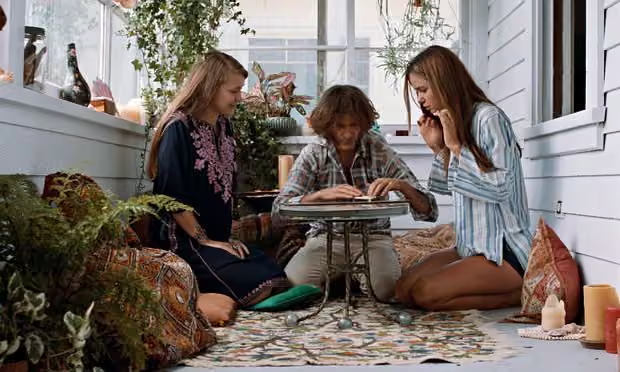


 For the score, Ramsay recruits Jonny Greenwood for the second time after her 2011 film We Need to Talk About Kevin. Like Joe’s character, the score flits between intense pieces with a strong and consistent beat which are usually played when he is on the job and more natural and flowing pieces which provide a backing track for scenes with Nina and his mother. The track, “Tree Strings”, which is played as Joe buries his mother is such a poignant moment and the music elevates the scene by assisting in his ephiphany to rescue Nina from her kidnappers. Greenwood is more widely known for his collaborations with Paul Thomas Anderson but his scores for both We Need to Talk About Kevin and You Were Never Really Here assist in elevating and excuting Ramsay’s vision to perfection.