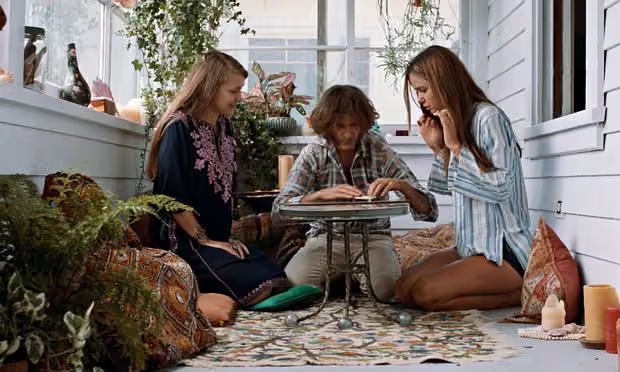
If ever there was a director bold enough to take on an adaptation of postmodern behemoth Thomas Pynchon, it’s Paul Thomas Anderson. Inherent Vice is based on the 2009 novel of the same name set in 1970s California. Anderson sets himself a difficult challenge as the first (and still only!) person to adapt Pynchon for the screen. Remarkably enough, he even received Pynchon’s support which is incredible considering how much of a recluse the author is.
Inherent Vice is the most straightforward text as far as plot and setting goes as the focus on a singular character, Doc Sportello (Joaquin Phoenix) makes the film more accessible than say Gravity’s Rainbow which has hundreds of named characters. Phoenix delivers another knockout performance as the aloof Sportello, a drugged out cop trying to find his missing ex-girlfriend, Shasta (Katherine Waterston).
Waterston is the “find” of the film, gaining her mainstream breakthrough with her portrayal of Shasta Fay Hepworth. While other characters including Doc and Lieutenant Christian F. “Bigfoot” Bjornsen (Josh Brolin) are larger than life caricatures, Shasta is the heart of the film and acts as its emotional anchor. Not only does Waterston hold her own against Phoenix’s transformative performance, but her presence is felt throughout the film, despite only being onscreen for around 15 minutes of the film’s 148-minute runtime.
The score is provided by longtime collaborator, Jonny Greenwood who taps into the mystery elements of the plot. While the songs on the soundtrack emphasise the uplifting hazy dreamland of hippie California, Greenwood’s score brings a darker edge with lovely motifs that linger and repeat throughout the film. The “Shasta” tracks are wonderful, getting longer and more complicated as the film goes on.
As a fan of Pynchon and the novel in particular, I understand why this one was picked to adapt out of all of them as he’s not a writer for the light-hearted. Even after the unique use of syntax and whirlpool of characters, he introduces drug-fuelled ideas that only make relative sense once you allow yourself to be fully immersed in the text.
The unfamiliarity of the source material can be off-putting for some, but it’s a great film with a brilliant script. A highly underrated film, it’s not one to underestimate.
One of the most hyped films to come out of 2021 was Denis Villeneuve’s Dune which boasted one of the best casts and a huge budget, incorporating plenty of advanced special effects that have given a new sci-fi franchise room to thrive. Dune is based on the 1965 novel of the same name, written by Frank Herbert and was often regarded as “unfilmable” due to the enormous scope of Herbert’s universe. It follows Paul Atreides (Timothée Chalamet), the heir of the House of Atreides, who is gifted with powers bestowed upon him by his mother, Lady Jessica (Rebecca Ferguson), who is a member of the Bene Gesserit, a religious sect that strictly trains the body and mind to achieve things that ordinary people can’t. When the desert planet of Arrakis is under attack by the power-hungry Baron Vladimir Harkonnen (Stellan Skarsgård), Paul must master his powers and team up with the inhabitants of Arrakis, including a young woman called Chani (Zendaya) to overthrow the Baron and restore peace to the planet.
Denis Villeneuve is one of the most talented directors working today and he proves this with Dune. Villeneuve has worked in many other genres in his career but no project has been bigger than Dune. The result is absolutely spectacular despite the many challenges that a story like Dune has. It is a story with many characters and many moving parts, but Villeneuve never overwhelms the viewer with more than they can handle, while also ensuring that enough of the character is brought through. There are lots of star-studded films that feel overwhelmed by the scope of the actors but this isn’t the case with Dune, and this is because of Villeneuve’s impeccable directing. The actors really become their characters and where performances in sci-fi blockbusters are usually grand, the performances in Dune are more subdued and substantial.
Leading the film is Timothée Chalamet. who has proven to be one of the best young actors working today. Ever since his breakthrough performance in the 2017 film, Call Me By Your Name, which brought him an Oscar nomination, Chalamet has been leading all kinds of films from autobiographical dramas (Beautiful Boy) to period dramas (The King) to comedies (The French Dispatch). Dune allows Chalamet to showcase further range within the sci-fi field in the role of the protagonist, Paul Atreides, which he does with ease. What is great about Chalamet’s performance is that he showcases Paul’s struggle to master his powers while also facing pressure as the heir of his house. Despite his young age, there is a lot of responsibility on Paul’s shoulders and Chalamet brings forth Paul’s naivety and flawed nature rather than making him seem like a man who has all the answers. The scene in which Paul is tested by the Reverand Mother of the Bene Gesserit, Gaius Helen Mohiam (Charlotte Rampling), is a masterclass in acting as we feel the physical and mental pain that the character is enduring.
Arguably the most important character in Dune is Chani, the young woman who lives on Arrakis and fights back against those who try to oppress its people. Playing Chani is Zendaya, who is another actor that has proven a huge range at such a young age. The battle for Arrakis is not one that is grounded in power for Chani, but rather the fight for her home and to live a peaceful life. This means that the character’s motives are completely different from the House of Atreides and Paul in particular. However, as events unfold, Chani and Paul find that they have a lot in common and agree to work together in order to overthrow the Baron. The little we see of Zendaya shows a lot of promise for the upcoming films in which Chani has more presence as she showcases the loss that Chani has and her resilience.
In a film as vast and heroic as this, there has to be a villain that steps up to the plate and an excellent performer who can effectively put this across. The role of Baron Vladimir Harkonnen is filled with greed and corruption and is a difficult role to successfully pull off and Villeneuve entrusts none other than the fantastic Stellan Skarsgård to step up to the task. Skarsgård’s performance not only lies in the intimidating physicality of the character, but the unpredictability of his actions and the relentless nature he has in order to get what he wants and successfully reap back the power he believes he wrongly lost. Skarsgård isn’t in the film a lot, but the scenes that include him are among the best in the film, including the scene in which he has captured Duke Leto Atreides (Oscar Isaac). It’s a testament to his performance that his presence is felt throughout the film, even in the scenes that he is not in and it will be exciting to see the Baron and Paul’s eventual standoff in the upcoming films.
Although the film is filled with brilliant performances, the real highlight for me was Hans Zimmer’s score which undeniably contains traces of Zimmer’s signature sounds but also combines a new sound that enhances the overall experience. It’s difficult to pinpoint one track that stands out because the music flows so naturally with the film and works perfectly to highlight the struggles that Paul is facing. What Zimmer has always done brilliantly is incorporating vocals into his tracks, which is what makes the music in Gladiator so entrancing. For Dune, he takes a similar approach with tracks such as “Gom Jabber” boasting aggressive vocals that provide an otherworldly feel, while using instruments such as bagpipes in the track “Arrival on Arrakis” shows the unpredictability and clashing nature that Villeneuve is capturing. Hopefully, Zimmer’s work will get rewarded with a deserved second Oscar win.
It’s difficult to talk about a film like Dune and not discuss the cinematography. What Greig Fraser manages to achieve is astonishing as he captures a world that is vast and seemingly endless, while contrasting it with feelings of entrapment and claustrophobia at the same time. It is thanks to Fraser’s use of the camera that we are able to explore the planet of Arrakis through Paul’s perspective, so it feels as though the audience is on the journey with the protagonist. Despite the abundance of special effects in the film, Fraser makes the landscape seem as natural and real as possible, truly allowing the audience to escape and feel as though Arrakis could be real.
Dune is one of those books that has always proven to be difficult to film, but what Villeneuve does is enhance the grittiness and realism of the story and uses the special effects fantastically to transport us to Arrakis. It’s no surprise that Dune has received so many award nominations and it is certain to swipe the technical categories thanks to the immersive experience. Dune: Part Two is sure to be just as exciting and thrilling as the first installment as it will explore Chani’s character more and follow Paul’s improvements. A star-studded spectacle that works beautifully and showcases blockbusters at their very best.
What did you think of Dune? Let me know in the comments below!